Why Late Summer Is Peak Bed Bug Season in Portsmouth, VA: Travel Tips and Home Prevention
By the time August turns into September, our phones at Bug-Masters ring more often — and the reason is almost always the same. Portsmouth, VA families are returning from summer vacations or sending kids back to college housing, and they are finding something unwelcome in their bedrooms. Bed bugs. Late summer is the seasonal peak, driven by heat, travel volume, and biology stacking up to make August and September the worst months of the year for bed bug introductions across Hampton Roads. Understanding this window — and how to respond quickly — can be the difference between a small problem and a months-long ordeal that requires expert bed bug treatment Portsmouth VA homeowners can rely on.
Why Late Summer Is the Highest-Risk Season for Bed Bugs in Portsmouth, VA
Bed bug activity climbs sharply through the summer and hits its highest levels between late July and the end of September. Two forces stack on top of each other in Portsmouth. The first is temperature. Bed bugs are cold-blooded, and their development is tied directly to ambient heat. In a Portsmouth home held at 82°F during a humid August week, a bed bug can complete its full development from egg to adult in about 14 days. In cooler months, that same cycle stretches to 60 or 70 days. A small introduction of a few bugs in mid-July can explode into a serious infestation by early September if it goes unnoticed.
The second force is human movement. Late summer is one of the busiest travel periods of the year for Portsmouth, VA residents — beach vacations, family reunions, cruises out of Norfolk, trips down to the Outer Banks, weddings, and back-to-school moves all cluster into a compressed window. The National Pest Management Association estimates that roughly one in five Americans has either had a bed bug infestation or knows someone who has, and the majority of those introductions trace back to travel. Combine that with the humidity that defines coastal Virginia in August, and Portsmouth becomes a near-perfect environment for bed bugs to establish quickly.
How Bed Bugs Travel from Hotels to Portsmouth Homes
Bed bugs do not fly or jump. They move by clinging to fabric and belongings, and they are exceptionally good at it. A typical adult bed bug is only about the size of an apple seed, and the nymphs are much smaller and lighter in color, making them nearly invisible against sheets, luggage linings, and pale upholstery — which is exactly what makes hotels and vacation rentals such reliable transfer points.
Here is how the chain usually works. You check into a coastal rental for a long weekend, and your suitcase goes on the bed or floor while you unpack. If bed bugs are present in the mattress, box spring, or nearby baseboards, they follow the carbon dioxide from sleeping guests overnight and end up on or near your bag — some crawling into luggage seams, others tucked into clothing on a chair. A few days later, you drive home, drop your suitcase on your Portsmouth bedroom floor, and the process repeats in reverse.
The U.S. Environmental Protection Agency classifies bed bugs as a public health pest and identifies hotels, rentals, and used furniture as the most common transmission points. Portsmouth, VA residents are not doing anything wrong when they bring bed bugs home from a trip — this is simply how the pest spreads. What matters is what you do in the first 48 hours after you return, and whether you catch the early warning signs before the population settles in.
Early Warning Signs of a Bed Bug Infestation
Bed bugs are nocturnal and shy, so the visual signs of an infestation usually show up before the bugs themselves. In the first week or two after any late summer trip, these are the indicators to watch for.
- Unexplained bite clusters: Small, red, itchy welts that appear overnight — often arranged in a line or zigzag on exposed skin like arms, shoulders, or ankles. Reactions vary widely; some people never react visibly, so a lack of bites does not mean you are clear.
- Rust-colored or dark spots on bedding: Check the seams of your mattress, along box spring edges, on pillowcases, and near the headboard. Bed bugs leave brownish or reddish stains from digestion and from being crushed at night.
- Shed exoskeletons: Bed bugs molt five times as they grow. The pale, translucent shells collect in cracks, along mattress piping, and inside drawer joints. Several shells in one spot is a strong signal.
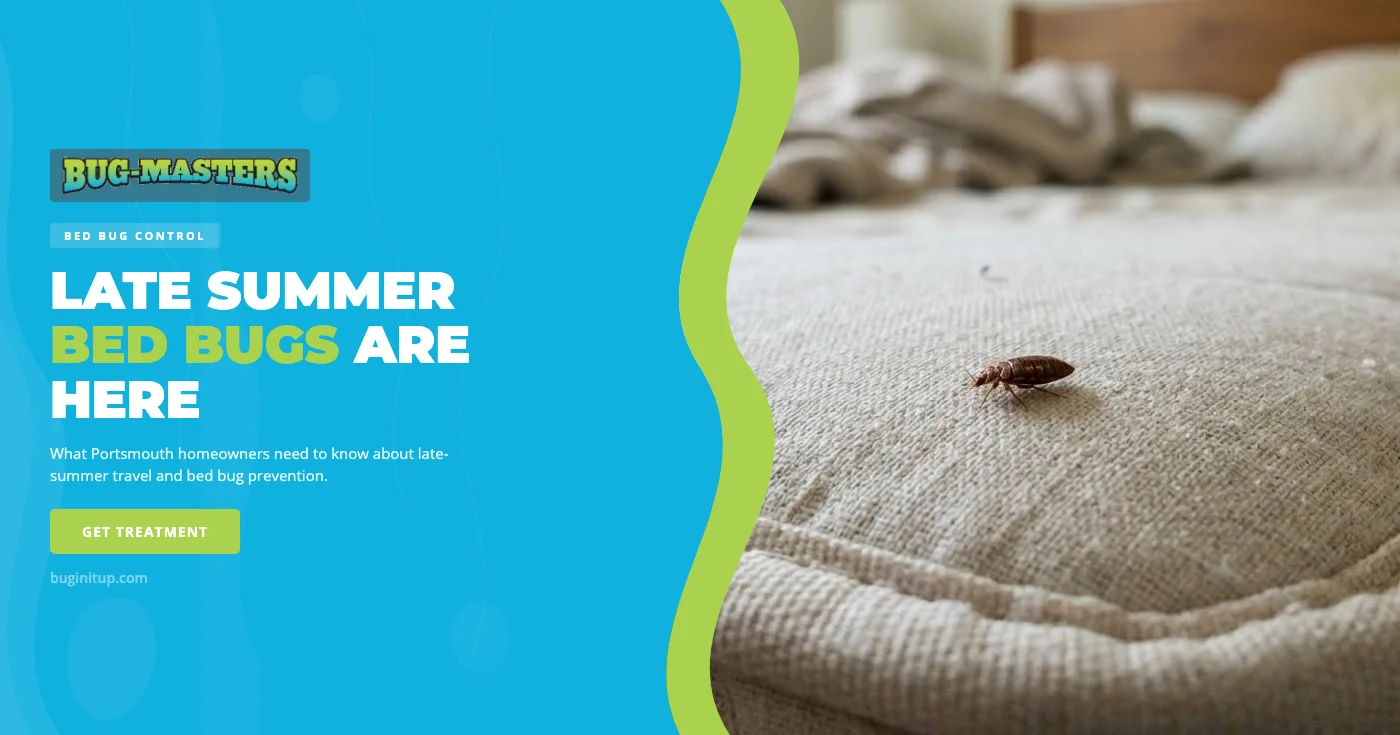
- Live bugs: Adult bed bugs are reddish-brown, flat, and oval — about 5 to 7 millimeters long. Nymphs are smaller and lighter. Check the tufts and folds of your mattress with a flashlight, particularly along the head of the bed.
- Musty, sweet odor: Larger populations often produce a distinctive sweet, musty smell, sometimes compared to coriander or overripe berries.
- Small pale eggs: Bed bug eggs are about 1 millimeter long, pale white, and often clustered in tight cracks. Their presence confirms an actively reproducing group.
The Virginia Cooperative Extension publishes detailed identification guidance for Virginia homeowners. Misidentification is one of the most common problems we see — bat bugs, carpet beetles, and some cockroach nymphs look similar at a glance, and treating for the wrong pest wastes weeks.
What to Do When You Suspect Bed Bugs: A Step-by-Step Response
If you have noticed bites, stains, or actual bugs in your Portsmouth home, the steps you take in the next few days will shape how quickly the problem gets resolved. Panic is understandable; methodical action is what works.
1. Do not start throwing furniture away. Discarding a mattress feels productive, but it usually spreads bed bugs to other rooms and to neighbors, and the empty spot gets re-infested from bugs still hiding elsewhere. Save disposal decisions for after a professional inspection.
2. Do not spray store-bought pesticides yet. Consumer sprays rarely reach the deep hiding spots where the majority of the population lives, and many bed bug strains have developed resistance to common active ingredients. Spraying often causes bugs to scatter into new rooms, making eventual professional treatment harder.
3. Confirm the identification. Capture a bug in a sealed plastic bag — do not crush it. Take clear photos of any stains, shed skins, or eggs. If you are unsure whether what you are seeing is a bed bug, our team can confirm during a professional inspection before any treatment is scheduled.
4. Reduce hiding surfaces without moving things around too much. Strip your bedding, wash it on hot, then run it through a hot dryer cycle for at least 30 minutes. Vacuum the mattress seams, box spring, and floor around the bed with a HEPA-filter vacuum, then immediately empty the canister into a sealed plastic bag and dispose of it outside.
5. Contain, do not spread. Keep sleeping in your bedroom rather than moving to the couch — bed bugs will follow the CO2 from your breathing, and switching rooms often introduces them to new areas. Encase the mattress and box spring in bed bug-proof covers if you have them.
6. Call for a professional inspection. The sooner our team is in your Portsmouth home, the smaller the problem is likely to be. Early-stage infestations are dramatically easier to resolve than populations that have spread for two or three months.
Professional Bed Bug Treatment Options in Portsmouth, VA
Professional bed bug treatment in Portsmouth, VA is not a one-size-fits-all service. Effective treatment starts with a thorough inspection, followed by a plan matched to the size of the population, the layout of the home, and the amount of furniture involved. Our team walks Portsmouth homeowners through the options during the initial visit so you understand what is being done and why.
Heat treatment uses portable equipment to raise the interior temperature of a home or specific area to a level that kills bed bugs at every life stage, including eggs. Because heat penetrates cracks, mattress seams, and wall voids that liquid products cannot reach, it is often our recommended approach for infestations that have spread beyond the bedroom. A heat treatment usually takes a single day, and our team handles all the setup, monitoring, and takedown.
Targeted chemical treatment uses professional-grade products applied only in the harborage areas identified during inspection — mattress seams, headboards, baseboards, and furniture joints. These products are engineered to work on resistant bed bug strains that shrug off consumer sprays, with residual formulations that keep working on bugs emerging from hiding. Chemical treatment is typically staged across two or more visits to catch bugs that hatch from eggs after the first round.
Integrated approaches combine heat with targeted chemical treatment and structural work, such as sealing cracks in baseboards and encasing mattresses. This is the most common recommendation for larger or long-established infestations in Portsmouth homes, because it addresses both the bugs and the environmental conditions that let them establish.
Follow-up inspections are built into every treatment we perform. Because bed bug eggs can hatch up to two weeks after treatment, we schedule return visits to verify results and address any bugs that emerge from previously undetected harborage. A professional plan is a sequence, not a single visit — following through on the sequence is what separates a successful treatment from a rebound infestation. Beyond bed bugs, our full range of pest services covers the ants, roaches, mosquitoes, spiders, and rodents that Portsmouth residents deal with year-round.
How to Prevent Bringing Bed Bugs Home After Vacation
The best bed bug treatment Portsmouth VA families can invest in is the one they never have to schedule. A few consistent habits during and after every summer trip can significantly reduce the risk of bringing bed bugs home.
Inspect your room before unpacking. When you arrive, place your luggage in the bathtub or on a hard tile floor — never on the bed, upholstered furniture, or carpet. Use your phone flashlight to check the mattress seams, especially at the head of the bed. Pull back the sheets and look along the piping, and inspect the seams of any upholstered chairs. If you find any evidence, request a room change to a different floor.
Keep your suitcase off soft surfaces. Use the luggage rack if the room provides one, but pull it away from the wall and inspect it first. Better yet, keep your bag in the bathroom or on a hard-surfaced closet shelf for the length of your stay.
Do not bring home used items casually. Used furniture, mattresses, and upholstered items are a documented source of bed bug introductions. If you must bring something home, inspect it thoroughly outdoors before it enters the house.
Unpack on a hard surface when you return home. Unload your suitcase in the garage, on the porch, or in a bathroom rather than on your bed. Send every washable item straight to the dryer on high heat for at least 30 minutes before putting it away — the dryer, not the washer, is what kills any bed bugs or eggs that came along.
Monitor for two weeks after any trip. Bites and stains often take several days to appear, and the population needs time to establish before it becomes obvious. If you see any of the early warning signs after a late summer trip, do not wait for confirmation.
Late summer bed bug problems in Portsmouth are largely preventable, and the introductions that do happen are highly manageable when they are caught early. What turns a small problem into a large one is delay. If you have returned from a summer trip and something in your bedroom looks off, reach out to Bug-Masters and let our team confirm what is going on and, if needed, put together a bed bug treatment plan built around your Portsmouth home. Helping local families take their bedrooms back from bed bugs is exactly the work we are here to do.