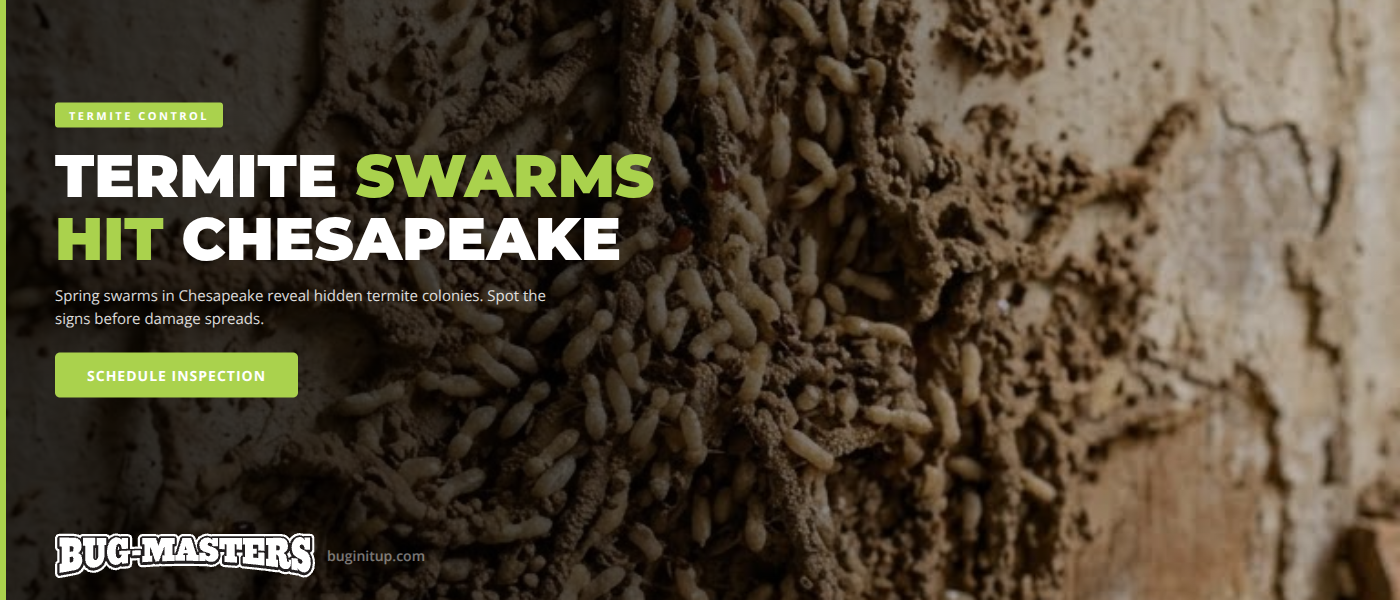
Every spring, homeowners across Chesapeake, VA notice something they didn't see all winter — clouds of dark, winged insects pouring out of foundations, mulch beds, and porch corners on the first warm afternoon after a rain. Most assume they're flying ants. Often, they aren't. Those swarmers are eastern subterranean termites, and the swarm itself is usually the first visible sign of a colony that has already been working under the home for years.
Effective termite control in Chesapeake, VA starts with knowing what a spring swarm looks like and how quickly to act once you spot one. At Bug-Masters, we've spent decades inspecting termite-prone homes across Hampton Roads, and we wrote this guide for the homeowner who just found wings on the windowsill — or wants to make sure they never do.
Subterranean colonies live underground year-round, but they only release reproductive swarmers — called alates — once a mature colony is large enough to spin off new ones. In coastal Virginia, that release is triggered by a specific combination: warm air (typically above 60°F), high humidity, and a recent rain. Spring delivers all three on schedule, which is why swarm season in Chesapeake runs from late February into May, with the heaviest activity in March and April.
The eastern subterranean termite (Reticulitermes flavipes) is the dominant species across Virginia and the most widely distributed subterranean termite in North America, according to University of Maryland Extension. Local colonies overwinter just below the frost line, then push swarmers up through mud tubes and soil cracks once spring conditions hold steady. After a storm, hundreds of alates fly out at midday, mate, drop their wings, and burrow back into damp soil to start new colonies.
The takeaway for Chesapeake homeowners is simple: a spring swarm isn't the start of a termite problem — it's the announcement that a mature colony, already several years old, has reached reproductive size. The swarm just made it visible.
The most common mistake we see during swarm season in Chesapeake is homeowners brushing wings off a windowsill and assuming they came from flying ants. Telling the two apart is straightforward once you know where to look — and it matters, because the two pests call for completely different responses.
Subterranean swarmers are roughly 1/4 to 3/8 inch long, dark brown or nearly black, with four equal-length wings that extend well past the body. Their bodies are uniform — head, thorax, and abdomen blend into one straight tube with no narrowing — and their antennae are straight and beaded. Flying ants — most often carpenter ants in our area — share the spring season but look quite different up close. Three quick checks separate them every time:
The wings themselves are another telltale clue. Termite wings shed within minutes of landing, so small piles of clear, equally sized wings on a windowsill, along baseboards, or around exterior light fixtures is stronger evidence than catching the swarmers in flight. If you find wings without bodies, treat it as termite evidence until proven otherwise.
Outside the swarm itself, subterranean termites leave several other clues homeowners across Chesapeake can spot during a careful walk-around — most at or near ground level, where termites move between soil and wood. The most reliable indicators include:
Spotting any of these signs in Chesapeake during March, April, or May warrants a professional inspection. The colony driving a swarm has likely been active for three to five years before you notice it.
Spring is when termites are most visible, but in Hampton Roads they never really shut down. Chesapeake sits in one of the most termite-prone climate zones in the eastern United States, and effective termite control has to account for that year-round pressure.
Three local factors drive it. Our soils are sandy and shallow with a high water table — perfect for moisture-loving subterranean species. Average annual rainfall across Hampton Roads runs above 47 inches, most of it falling between April and October when colonies forage hardest. And mild Chesapeake winters rarely freeze deep enough to slow colony activity; eastern subterranean termites simply move down a few inches and continue feeding through the cold months. According to Virginia Cooperative Extension partners, this pressure is broadly true across the Tidewater region.
Slab homes, properties near tidal creeks, and any structure with wood within six inches of soil carry elevated risk — and year-round monitoring is what keeps Chesapeake homes ahead of it.
Termites don't take days off. A single mature subterranean colony can house several hundred thousand workers tunneling through wood around the clock. By the time a homeowner notices a sticking door or soft spot, the colony has often been feeding inside the structure for years. Nationwide, termites cause more than $5 billion in property damage annually, and most of it isn't covered by standard homeowner's insurance because it's classified as preventable. The most common hidden damage we encounter in Chesapeake includes:
The hardest part for homeowners is that subterranean termites preserve the outer shell of the wood while consuming the inside — which is why visual inspection alone is not enough.
The best time to schedule termite control in Chesapeake is now — not after you've already found wings on the windowsill. We recommend an annual inspection for every home in the area, with priority timing in February or early March for owners who want a clean baseline before swarm season starts.
You should reach out sooner — outside the annual schedule — if any of the following apply:
A professional termite inspection in coastal Virginia covers the perimeter foundation, crawl space, accessible structural wood, and soil-to-wood contact points around decks, porches, garages, and additions. We document findings, photograph any active or historic damage, and recommend treatment only where warranted — bait stations, targeted liquid treatments, or full-perimeter barriers depending on the structure.
At Bug-Masters, our termite control in Chesapeake, VA is built around the long-term life of the home, not just the swarm in front of you. Every job starts with a thorough property inspection — foundation, crawl space, and exterior wood-to-soil contact points walked, photographed, and documented before we recommend a single treatment.
From there, our technicians design a plan around the structure's actual risk profile. Homes with active subterranean activity get colony elimination and wood protection; homes with no current activity get monitoring stations and barrier strategies that interrupt colonies before they reach the structure. We serve Chesapeake, Virginia Beach, Norfolk, Portsmouth, Suffolk, Hampton, and Newport News, and many Chesapeake customers pair termite service with crawl-space moisture work since the two issues feed each other. Reach out through our contact page for a free property assessment before peak swarm season builds.
Eastern subterranean termite swarms in Chesapeake typically begin in late February and run through May, with the heaviest activity in March and April. Swarms occur on warm, humid afternoons — usually above 60°F — within a day or two of a spring rain. Coastal Virginia's mild springs often push the first swarms a few weeks earlier than inland parts of the state.
Check the wings, waist, and antennae. Termites have four equal-length wings well past the body, a uniform body with no pinched waist, and straight beaded antennae. Flying ants have a pinched waist, elbowed antennae, and two pairs of wings of different sizes. Small piles of equally sized clear wings on a windowsill are one of the strongest indicators of a termite swarm.
Don't spray the swarmers — they aren't the colony. Vacuum a few wings into a sealed bag (without crushing them) so a technician can confirm the species, then schedule a termite inspection right away. The visible swarm is the surface of an established colony already working under the home.
Yes. Eastern subterranean termites continue feeding through winter in coastal Virginia, just deeper in the soil and inside the structure. Mild Chesapeake winters rarely freeze hard enough to slow colony growth, which is why annual inspections matter — not just spring ones.
Once a year is the right baseline for most Chesapeake homes. Properties with prior activity, crawl-space moisture issues, or wood-to-soil contact may benefit from inspections every six months. Buying or selling a home almost always requires a wood-destroying-insect (WDI) report at closing.
Yes. Bug-Masters provides termite control in Chesapeake, VA and across Hampton Roads, including Virginia Beach, Norfolk, Portsmouth, Suffolk, Hampton, and Newport News. Reach out through our contact page to schedule a free property assessment before peak swarm season builds.
Yes. Our technicians follow all label instructions and walk you through the products and methods used during your assessment, plus any steps to take before or after each treatment so your family and pets stay comfortable.