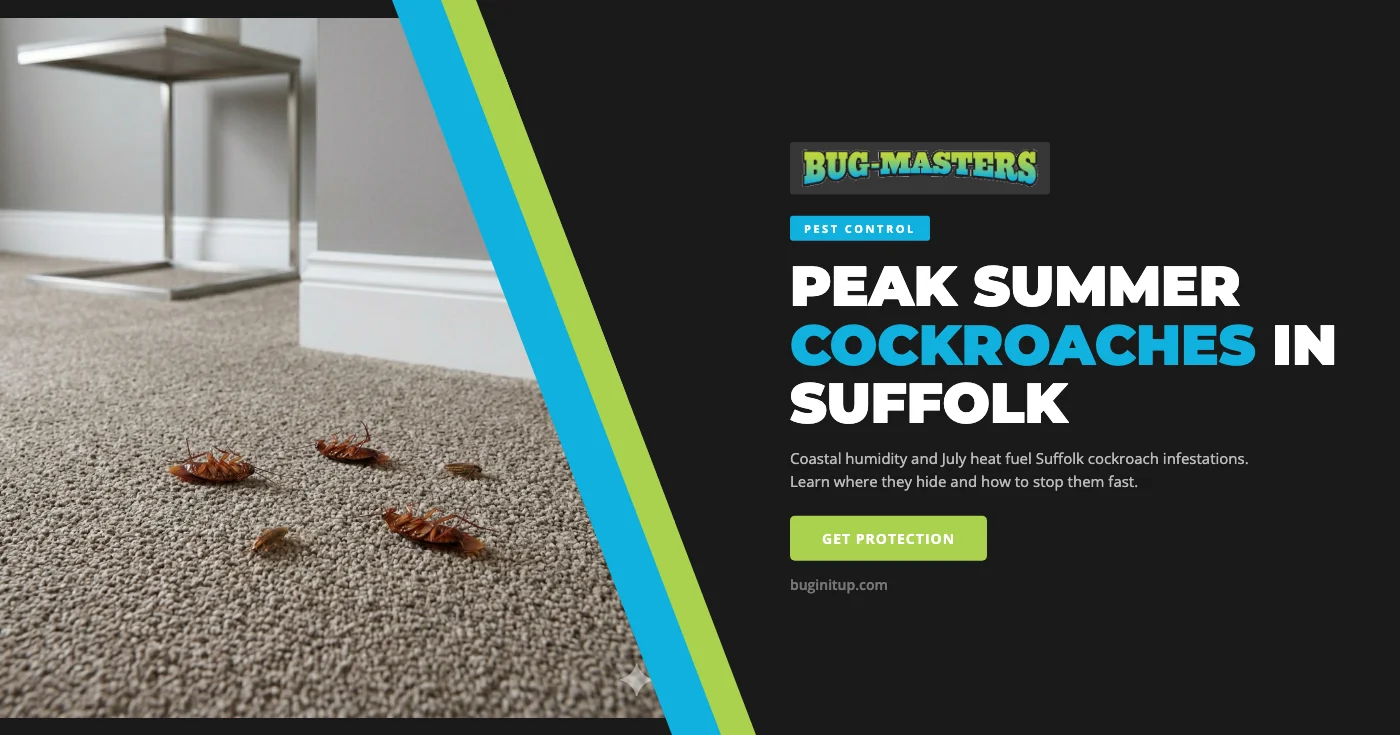
July doesn't just heat up Suffolk — it kicks off cockroach season across coastal Virginia. Once Nansemond River humidity settles in and overnight lows stop dropping below seventy, our crews run the same call over and over: brown insects skittering across a kitchen counter at midnight, a musty smell behind the dishwasher, pepper-grain droppings along a baseboard.
Effective cockroach control in Suffolk, VA starts with understanding why this corner of Hampton Roads pushes roaches indoors so reliably. At Bug-Masters, we've worked Suffolk cockroach jobs for years, and the pattern is consistent: coastal humidity, warm nights, and small structural openings turn ordinary homes into ideal roach habitat. This guide covers what to watch for, how coastal conditions fuel the July surge, and what actually keeps roaches out through the rest of summer.
Cockroaches are tropical insects at heart — they need moisture to survive, warmth to reproduce, and tight harborage to feel secure. Suffolk in July checks every box. Daytime highs sit in the mid-to-upper eighties, overnight lows stop falling below seventy, and humidity hangs above 70% well into evening. That combination compresses the reproductive cycle: German cockroach females produce five to eight egg cases across their lifetime, each holding 30 to 40 nymphs, and warm humid conditions shorten the egg-to-adult cycle to roughly two months.
By July, populations that were still small in May have doubled, then doubled again. What began as one or two roaches under a Suffolk kitchen sink can turn into a full harborage inside a wall void by the Fourth of July. Older wood-frame homes near Bennett's Creek and Downtown Suffolk are especially vulnerable — crawl spaces stay damp, and the temperature gap that suppresses winter activity has closed. Suffolk cockroach exterminator calls peak between mid-July and Labor Day.
Almost every Suffolk cockroach job we run involves one of two species, and the treatment plan is different for each. Here's how our technicians distinguish them in the field:
Two other species show up in smaller numbers across Hampton Roads. Oriental cockroaches — dark brown to black, about an inch long — favor damp basements and storm drains, and Virginia Tech notes their distribution runs heaviest in coastal port cities like Suffolk. Smoky brown cockroaches are shiny dark brown flyers that hover around porch lights and settle in soffits and along rooflines. Species drives everything from monitor placement to bait formulation, so we identify before we treat.
Roaches are nocturnal and secretive — a Suffolk homeowner can have hundreds in the walls before seeing one. The earliest signs show up as evidence, not sightings. Walk your kitchen and bathrooms with a flashlight and watch for:
One of these signs in June is a prevention opportunity. Two or three together in July is an active infestation that needs professional cockroach control in Suffolk, VA before the population doubles again in August.
Suffolk sits at the western edge of Hampton Roads, wrapped by the Nansemond River, tidal creeks, and thousands of acres of the Great Dismal Swamp. That geography keeps summer humidity notably high — July and August averages sit in the mid-70% range, with dew points in the low seventies that make coastal Virginia air feel thick well past sunset. Virginia Cooperative Extension puts it plainly: cockroaches must have a source of water for survival, and Suffolk's summer air alone supplies much of it.
Older Suffolk homes compound the problem. Crawl spaces sit low over soil that never fully dries. Slab penetrations for plumbing and HVAC create moisture bridges into wall voids. Bathrooms without exhaust fans hold condensation on tile long after a shower. Every one of those spots doubles as roach harborage: warm, damp, dark, tight against the body.
Summer thunderstorms add a second variable. Heavy rain saturates the ground around the foundation and drives American, Oriental, and smoky brown cockroaches indoors through any crack wider than a quarter inch. That's why post-storm cockroach calls spike sharply through July across the Hampton Roads region.
Roaches need three things to settle in: water, food crumbs, and a tight crack to hide in. Take any one of those off the table and the population struggles. Here are the five prevention steps we walk Suffolk homeowners through every summer:
Done together, these five steps prevent most of the established infestations Suffolk homeowners would otherwise face by the end of August.
Some Suffolk cockroach calls can wait a week. Others should not wait a night. Here's how we triage them:
Store-bought sprays and bait stations struggle against established colonies: repellent sprays scatter roaches into new wall voids, pre-packaged stations rarely land within a foot of active harborage, and consumer products almost never break the reproductive cycle — egg cases survive most sprays and hatch nymphs a week later. For a single American cockroach wandering in from the porch, a foundation seal and perimeter spray handle it. For German cockroaches breeding under a Suffolk kitchen sink, professional treatment is the reliable path.
At Bug-Masters, our cockroach work starts with species identification and harborage mapping — not blanket spraying. We choose the lowest-impact effective combination of gel baits, insect growth regulators, residual perimeter treatment, and structural exclusion, then follow up to verify the colony is gone. That inspection-first approach is why our Suffolk cockroach exterminator visits close out in fewer trips than most.
We've served Suffolk homeowners across Bennett's Creek, Downtown Suffolk, Harbour View, North Suffolk, and Whaleyville for years. Cockroach treatment pairs naturally with our broader pest services for households dealing with ants, spiders, mosquitoes, or seasonal rodents — a single visit can address the full pest load.
A Suffolk cockroach exterminator visit can usually be scheduled within 48 hours, and we offer free inspections during peak summer. Reach out through our contact page ahead of the August peak — the earlier we identify the harborage, the smaller the treatment plan.
July combines Suffolk's peak heat, overnight lows in the low seventies, and coastal humidity that regularly tops 70% — conditions that accelerate cockroach reproduction and push outdoor American roaches indoors through foundation gaps after every heavy summer rain. German cockroaches already breeding in wall voids also expand into kitchens and bathrooms as populations double through midsummer.
Start with moisture — fix every drip, run a dehumidifier if humidity stays above 60%, and pull the refrigerator out to vacuum coils behind it. Store dry goods and pet food in airtight containers and empty the trash nightly. For a confirmed German cockroach infestation, professional treatment combining gel baits inside cabinet voids with an insect growth regulator is far more effective than any consumer spray.
Cockroaches don't bite, but their droppings, shed skins, and egg cases carry allergens linked to asthma attacks and respiratory irritation — particularly for children. The American Lung Association ranks cockroach allergens among the top indoor triggers for chronic asthma. Roaches also carry bacteria from drains and trash onto food-prep surfaces.
Yes. Bug-Masters provides cockroach control in Suffolk, VA and across Hampton Roads, including Virginia Beach, Norfolk, Chesapeake, Portsmouth, Hampton, and Newport News. Reach out through our contact page to schedule a free inspection ahead of peak summer roach season.
Most Suffolk German cockroach jobs show a visible drop in activity within seven to ten days of the first treatment, and populations typically close out over two to four visits spaced two weeks apart. American and Oriental cockroach entries usually resolve after a foundation seal plus a perimeter residual, often in a single visit with a follow-up inspection.