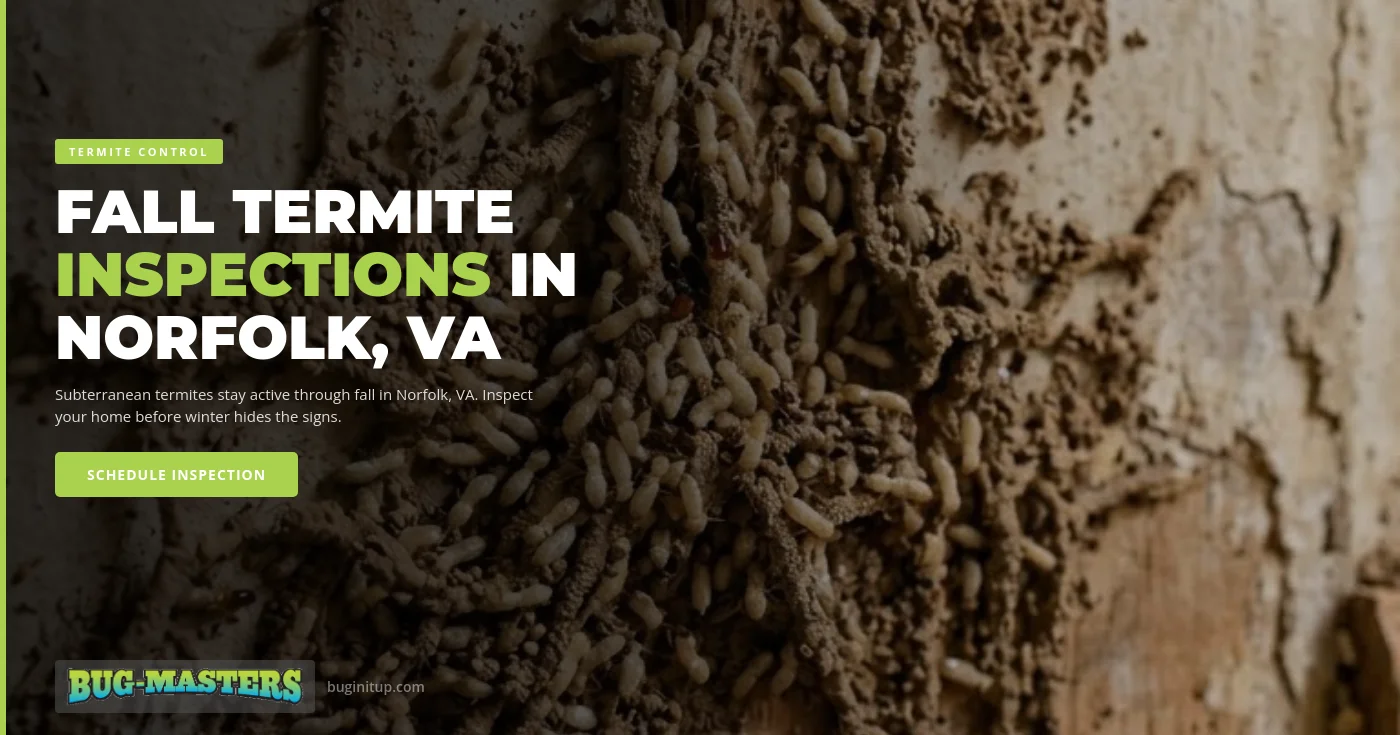
Fall is the last clear window Norfolk homeowners have to catch termite damage before winter weather makes it genuinely difficult to see. The leaves drop and pile against the foundation. Pine straw and tarps go over outdoor furniture. Holiday decorations get stacked along crawl space hatches. And by late December, the exact places termites feed are the places nobody is looking. At Bug-Masters, we schedule more termite inspection Norfolk VA calls in October and early November than any other stretch of the year — and the reason is simple. Subterranean termites in Hampton Roads do not stop feeding when the air cools. They keep working inside the walls while the signs go quiet on the outside.
Eastern subterranean termites (Reticulitermes flavipes) are the dominant termite species in Norfolk and across the broader Hampton Roads region. Unlike many insects that go dormant when the air chills, these termites live below the frost line in soil that stays well above dormancy temperatures year-round in coastal Virginia. The Virginia Cooperative Extension notes that subterranean colonies continue foraging as long as soil temperatures remain above roughly 50°F — and in Norfolk, the top foot of soil where termites travel typically stays above that threshold through most of the winter.
What that means for a Hampton Roads homeowner is straightforward. Termites that found your sill plate in July are still eating it in November. Colonies that found your crawl space joists in September are expanding across more framing in October and early winter. The slower surface temperatures do not stop the colony — they simply hide the evidence by driving termites deeper into the warm, humid wood where their galleries are invisible from the outside. A fall termite inspection catches that activity at the moment it is still accessible and still fixable.
Most of the warning signs we look for during a Norfolk termite inspection become harder to find once seasonal clutter accumulates around a home. The time to walk the perimeter and the crawl space is now, while visibility is best. Here is what we look for and what every homeowner should look for too:
October is the single best month to schedule a termite inspection in Norfolk, and for several practical reasons that have nothing to do with marketing calendars. First, the vegetation around most homes has thinned out. Groundcover dies back, shrubs lose density, and crawl space vents are no longer buried behind summer growth. Our inspectors can actually see the foundation and the perimeter — which is where almost every subterranean termite inspection begins.
Second, the timing works in your favor. Installing in-ground bait stations around the foundation requires a soil auger to cut a clean sleeve for each station, and trenching for a liquid barrier treatment goes smoothly in soft soil. October soil is cool but still soft, and a treatment installed now has eight to ten weeks to disperse and bind to soil particles before the coldest weather sets in.
Third, scheduling. Fall is quieter for most pest control crews than peak summer, and homeowners can usually get a two-hour inspection block within a week. In spring, when swarm season drives call volume up sharply, that same inspection may be a three-week wait.
Norfolk sits in what the U.S. Forest Service termite infestation probability map rates as a moderate-to-heavy termite pressure zone. The reasons are environmental, and they all compound each other in Hampton Roads.
The region's sandy loam over clay subsoil holds water near the surface, which keeps crawl space ventilation moisture readings high through most of the year. Tidal flooding in Ocean View, Larchmont, Colonial Place, and The Hague pushes brackish water into yards and under foundations several times a year, saturating the exact soil that termites forage through. Nor'easters and hurricane remnants wash out chemical soil barriers on homes that received perimeter treatments years ago, often without the homeowner realizing the barrier is gone. And Norfolk's housing stock skews older than the national average, with a high percentage of crawl space construction, pier-and-beam framing, and original sill plates that have been in contact with coastal moisture for sixty, eighty, or a hundred years.
All of that produces a high termite pressure environment for Norfolk homes. A home that has not been inspected in two or three years in Norfolk is a home that very likely has active termite activity somewhere in the structure — the only question is how far it has spread.
Winter does not actually prevent effective termite treatment. It just rules out a few specific options and favors others. The U.S. Environmental Protection Agency regulates all registered termiticides and categorizes them into three main approaches, two of which work well into Norfolk's cool season.
Liquid soil treatments using non-repellent termiticides such as fipronil or imidacloprid can be installed as long as the top foot of soil is unfrozen and workable. In Hampton Roads, that condition typically holds through most of winter except for occasional hard freezes. Workers carry the active ingredient back to the colony, and because the product is undetectable to termites, the colony receives it on a steady basis.
In-ground bait stations placed around the foundation perimeter continue to function all winter. Termites that encounter the stations feed on cellulose matrix laced with a slow-acting insect growth regulator and carry it through the colony across repeated foraging trips. Bait stations work on a time horizon of months rather than days, so a fall installation builds a protective ring that activates fully by early spring.
Direct wood treatment with borates handles drywood colonies and localized subterranean galleries without any soil work at all, which makes it a reliable cool-weather option.
What fall and winter typically rule out is new construction pre-treatment of exposed foundation slabs and large-scale fumigation tent work, which both require warmer ambient temperatures. For established homes with active or suspected infestations, the standard treatment paths remain fully available.
A proper fall termite inspection in Norfolk takes between ninety minutes and two hours on most homes, and it covers four zones methodically. Our inspectors move through the property in roughly the same order every time so nothing is skipped.
At the end of the inspection we deliver a written report with photos, a damage map, and a treatment recommendation that matches the species and the extent of what we found. If the home is clear, the report serves as a baseline for the next year's inspection. For homes with active activity, our termite treatment program lays out exactly what we recommend and why.
Finding termites in October is one thing. Keeping them out through the winter and into spring swarm season is another, and it is where a monitoring plan matters more than any one-time treatment. Our winter protection approach for Norfolk homes typically combines three elements: a perimeter liquid treatment or bait station ring installed in the fall, a crawl space moisture correction project where readings exceed 20% wood moisture content, and a scheduled inspection the following May to verify the colony has not re-established and to catch the spring swarm window before it starts.
Termite work also pairs well with our broader general pest control program, because the conditions that invite termites — crawl space moisture, foundation gaps, poor drainage, debris against sill plates — are the same conditions that invite carpenter ants, wood-decay fungi, and overwintering rodents. Fixing them once addresses several pest categories at the same time.
Bug-Masters provides termite inspections and treatment across Norfolk, Virginia Beach, Chesapeake, Portsmouth, Suffolk, Hampton, and Newport News. If you have seen mud tubes, swarmer wings, or soft framing anywhere on your property this fall, reach out through our contact page and we will schedule a full property assessment before the weather turns.
Are termites really active during winter in Norfolk, VA?
Yes. Eastern subterranean termite colonies in Norfolk stay active year-round because the top foot of soil holds temperatures above the roughly 50°F foraging threshold through most of the winter. Workers may slow during a cold snap, but the colony keeps feeding on wood in crawl spaces, sill plates, and framing where the structure itself holds warmth. We find active mud tubes on home inspections every month of the year in Hampton Roads.
How often should I schedule a termite inspection on a Norfolk home?
A professional termite inspection every twelve months is standard for Norfolk homes, and we recommend fall scheduling specifically so the inspection catches activity before winter clutter hides the signs. Homes with past termite history, homes near tidal flooding zones, and homes with crawl space moisture issues often benefit from a shorter six-month cycle. The annual inspection is also what keeps most termite bond warranties valid.
What happens if termite damage goes undetected through winter?
Subterranean termites in Norfolk can consume roughly a pound of wood every six weeks per active colony of 200,000 workers. A missed fall inspection often means an additional four to six months of feeding before the spring swarm forces discovery, which can translate to significant additional damage in sill plates, floor joists, and subfloor sheathing. The repair bill difference between a fall-caught infestation and a spring-caught one is typically substantial.
Does fall rain affect termite treatment effectiveness in Hampton Roads?
Rain during or shortly after a liquid soil treatment can affect how the termiticide binds to soil particles if the application was not timed properly, which is why we check the forecast carefully and typically schedule installs for a dry window. Bait stations are not affected by rain at all. Once a termiticide has bound to the soil column — generally within a few days — normal rainfall does not reduce its effectiveness. Major coastal flooding is a separate concern and is one of the reasons we recommend post-storm re-inspection on homes near tidal zones.