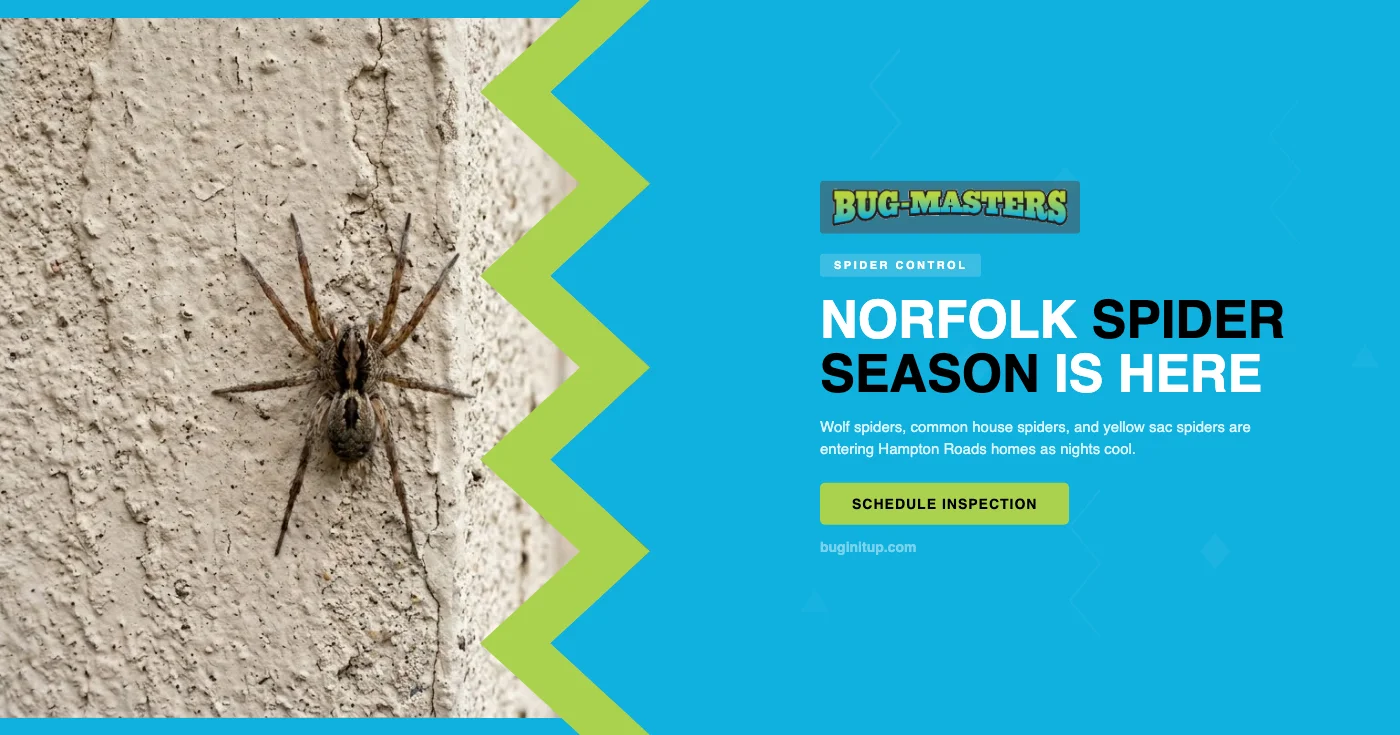
By the time August turns into September, our phones at Bug-Masters ring more often with the same question from Norfolk homeowners: "Why am I suddenly seeing spiders everywhere?" It happens like clockwork across Hampton Roads — the wolf spider crossing the kitchen tile at 11 pm, the fresh orb web spanning the back porch every morning, the cellar spider in every bathroom corner. Late summer is the seasonal peak for indoor spider activity, and if you are finding more spiders in your Norfolk, VA home this August, the reasons are biological, ecological, and specific to coastal Virginia. Understanding which species you are seeing and what actually works to keep them out is what gets most Norfolk homeowners through the season.
Why Late Summer Brings More Spiders Into Norfolk, VA Homes
Spiders do not appear from nowhere in August — they mature, migrate, and get noticed in August. Four forces stack up in Norfolk from the end of July through mid-September and together explain why sightings inside Hampton Roads homes climb sharply during this window.
Maturity. Most spider species in coastal Virginia hatched from egg sacs laid the previous fall and have been growing quietly through spring and early summer. By late August, the survivors are at their largest, most visible size of the year. The wolf spider you barely noticed in May is now the size of a silver dollar.
Mating season. This is the piece most Norfolk homeowners miss. In many house-associated species, females stay put on their webs releasing pheromones while males roam widely searching for them. That wandering behavior is what drives spiders across driveways, up siding, and through open garage doors and dryer vents. A fast-moving spider crossing your kitchen at 11 pm in August is usually a male on the move.
Temperature gradient. By late August in Norfolk, nights have started to cool while days are still hot and humid. That gradient pulls ground-dwelling and web-building spiders toward the sheltered edges of homes, garages, and crawlspaces where humidity and prey stay stable.
Prey volume. Mosquitoes bred through August storms, roaches thriving in coastal humidity, gnats swarming outdoor lights, and ants foraging indoors all peak at the same time. More prey means more spiders, because spiders settle wherever the food supply is reliable.
Common Spider Species Found in Hampton Roads This August
The spider ID calls we take from Norfolk in August cover a predictable set of species. Knowing which one you are looking at often decides whether it is a "leave it alone" situation or a "call the exterminator" situation.
- Wolf spiders. Large, hairy, ground-dwelling hunters that do not build webs. Per the Virginia Cooperative Extension, wolf spiders "are commonly found indoors in the fall when they are looking for a warm place for winter" and enter through gaps in window and door seals. Females carry their egg sacs on their spinnerets and later the hatchlings on their backs — a distinctive Norfolk-garage field mark in late August.
- Common house spider. Small, mottled brown, responsible for the messy irregular webs in garage corners, basement joists, and closet ceilings. Harmless and abundant across every Norfolk neighborhood from Ghent to Ocean View.
- Cellar spider (daddy long-legs). Thin-bodied with extremely long legs, hanging in loose webs in bathrooms, basements, and crawlspaces. Harmless and beneficial — they prey on other spiders that would otherwise establish nearby.
- Yellow garden spider and other orb weavers. The dinner-plate web across your porch railings overnight is almost always an orb weaver. The yellow garden spider is large and black-and-yellow with a zigzag stitching down the web center. Both peak in visibility from mid-August through October.
- Grass spiders. Yellowish-brown with two dark stripes down the back and a funnel web that opens into a horizontal sheet in lawns and mulch beds. Highly active in Hampton Roads late summer and among the fastest you will see when disturbed.
- Jumping spiders. Small, compact, often iridescent, with large front-facing eyes. They do not build webs and are more likely to watch you than bite.
- Yellow sac spider. Pale yellow to light green, small, and often found on interior walls and ceilings at night. They build silken retreat sacs in room corners rather than orb-style webs.
Which Norfolk Spiders Are Harmful vs. Harmless?
The overwhelming majority of spiders inside a Norfolk home in August are harmless to people and doing useful work eating other pests. Two categories deserve attention, and the rest almost never do.
The one Virginia species that genuinely warrants caution is the black widow. Per Virginia Tech's Spiders of Medical Concern in Virginia, both the northern and southern black widow occur commonly across the state. The female is identifiable by a "shiny black" body with a red hourglass on the underside of the abdomen. Widows prefer undisturbed spots — woodpiles, sheds, crawlspaces, rarely-opened storage bins, the underside of a grill lid. They are not aggressive, but they will bite when pressed against skin, which is exactly what happens when a hand reaches into the wrong shed corner during a late-summer clean-out. The brown recluse is not native to coastal Virginia, and confirmed encounters in Hampton Roads are rare. Most "brown recluse" reports we investigate in Norfolk turn out to be woodlouse spiders, spitting spiders, or unusually large cellar spiders.
The yellow sac spider occasionally bites when trapped against skin in bedding or clothing. Reactions are typically mild — a red welt that clears within a few days — but the bite is more frequent than widow bites because the species lives on interior walls where people are.
Everything else on the common Norfolk list — wolf spiders, house spiders, cellar spiders, orb weavers, grass spiders, jumping spiders — is harmless. Alarming to look at, occasionally, but not a medical concern.
How Spiders Get Into Your Norfolk Home and Where They Hide
Spiders do not chew their way into a Norfolk house — they walk in through gaps that were already there. The late-summer entry points are the ones most homeowners never inspect until a spider forces the issue.
Entry points to check. Worn or missing door sweeps on garage side doors and front doors. Dryer vent hoods with broken flaps. Crawlspace vents with torn screens. Utility penetrations where cable, gas, and refrigerant lines enter the exterior wall. Weep holes in brick that lack screening. Torn window screens. Attic gable vents in older Ghent, Larchmont, and Colonial Place homes where screening has aged out. Any gap large enough for a pencil is large enough for a wolf spider.
Where they hide indoors. Garage ceiling corners and rarely-opened storage bins. Basement and crawlspace joists. Behind the water heater and around HVAC lines. Window frames in humid bathrooms and laundry rooms. Inside boots, gloves, and pool towels in the mudroom. Above kitchen cabinets and the tops of picture frames.
Where they hide outdoors. Porch ceilings, eaves, and soffits. Around exterior lights that draw moths all night. Inside woodpiles and stacked patio furniture. Under decks and along the foundation. Along fence lines and inside shrubs that touch siding. Waterfront homes along the Lafayette River and Willoughby Bay pick up extra spider pressure from shoreline vegetation and dock structures.
DIY Spider Prevention Tips for Norfolk, VA Homeowners
Plenty of meaningful late-summer spider work does not require a professional. Before — or alongside — a service call, here is what we recommend every Norfolk homeowner do during August and September.
- Swap exterior bulbs for yellow LED "bug lights." Standard cool-white bulbs pull the most insects; yellow-spectrum LEDs draw far fewer moths and gnats, dropping the orb weaver population on your Norfolk porch within a few weeks by cutting the food supply.
- Knock down webs and egg sacs every few days with a long-handled brush or a shop vacuum on eaves, soffits, porch corners, and garage ceilings. Mechanical removal is the single most effective non-chemical step you can take.
- Seal the gaps. Replace worn door sweeps, install screening over crawlspace vents and dryer vent hoods, and caulk utility penetrations with silicone. Older Norfolk homes in Ghent, Colonial Place, and West Ghent often need attention where original weatherstripping has aged out.
- Pull mulch back from the foundation and aim for a 12-inch clearance between vegetation and exterior walls. Branches touching siding are direct spider highways.
- Address the underlying pest problem. Mosquitoes on the patio, ants in the kitchen, or roaches in the basement all feed spiders. You cannot out-spray a food supply.
- Declutter garages, sheds, and basements. Sealed tote bins are far less spider-friendly than open shelving with cardboard. Shake out shoes, gloves, and pool towels before use, especially anything that has sat all summer.
When to Call a Professional Spider Exterminator in Norfolk
Most late-summer spider sightings in a Norfolk home do not need a service call. A few webs on the porch and the occasional wolf spider crossing the laundry room floor in August are normal in Hampton Roads. We recommend professional spider control in Norfolk, VA when one of these patterns starts showing up:
- You are knocking down webs in the same spots multiple times a week and they keep coming back
- You are finding egg sacs, especially clusters of them in garages, sheds, crawlspaces, or storage bins
- You spot a black widow on the property — particularly in a woodpile, shed, crawlspace, or storage area
- You are seeing larger spiders inside the living space during daylight hours
- You have a known underlying pest problem driving the spider population
- Someone in the home is genuinely afraid of spiders to the point that sightings are affecting daily life
Our late-summer spider pest control service starts with a walk-through of the exterior and the key interior hot spots — garage, basement, crawlspace, bathrooms, and any room with a recent sighting. We map the active webs and egg sacs, identify which prey species are sustaining the population, and build a treatment plan targeting both the spiders and the food chain feeding them. We focus on the cracks, voids, and harborages where spiders actually live rather than only spraying open surfaces. Bug-Masters serves the full Norfolk service area along with Virginia Beach, Chesapeake, Portsmouth, Suffolk, Hampton, and Newport News.
Frequently Asked Questions
Are most spiders in Norfolk, VA dangerous?
No. The overwhelming majority — wolf spiders, common house spiders, cellar spiders, orb weavers, grass spiders, jumping spiders — are harmless and beneficial outdoors. The only Virginia spider that warrants real caution is the black widow, and yellow sac spiders can produce a mild welt if pressed against skin. Brown recluses are not native to coastal Virginia.
Why am I seeing so many more spiders in August?
Four things hit at once. Spiderlings that hatched last fall have reached full adult size. Males wander widely for mating season. Cooler nights and warm days create a temperature gradient that pulls spiders toward sheltered edges of homes. And late-summer insect populations — mosquitoes, ants, roaches, gnats — peak all at once, sustaining a bigger spider population than any other time of year.
How do I tell if I have a black widow in my Norfolk home?
Adult female black widows are shiny jet-black and roughly half an inch long in the body, with a bright red hourglass on the underside of the abdomen. Webs are tangled and irregular, almost always built in undisturbed dark spots — woodpiles, the back of a shed, a rarely-opened storage bin, the underside of a grill lid. If you think you have seen one, do not reach in. Take a photo from a distance and contact our team.
How long does professional spider control in Norfolk last?
It depends on the underlying pest pressure. Most Norfolk homes do well with a quarterly service cadence that addresses spiders alongside the prey species feeding them. A one-time treatment can clear an active late-summer population, but without addressing the supporting insects, spiders return within a season. Coastal Virginia humidity and prey volume make Norfolk a naturally spider-heavy environment, and quarterly maintenance is what keeps sightings occasional rather than routine.
Late summer is spider season across Hampton Roads, but it does not have to become a spider problem in your Norfolk home. A little exterior clean-up, the right bulbs on the porch, some caulk in the right gaps, and a call to our team when sightings start outpacing patience are usually all it takes. If you are finding more spiders in your Norfolk, VA home this August than feels normal, reach out to Bug-Masters — helping Hampton Roads families take their homes back from late-summer spider activity is the work we are here to do.