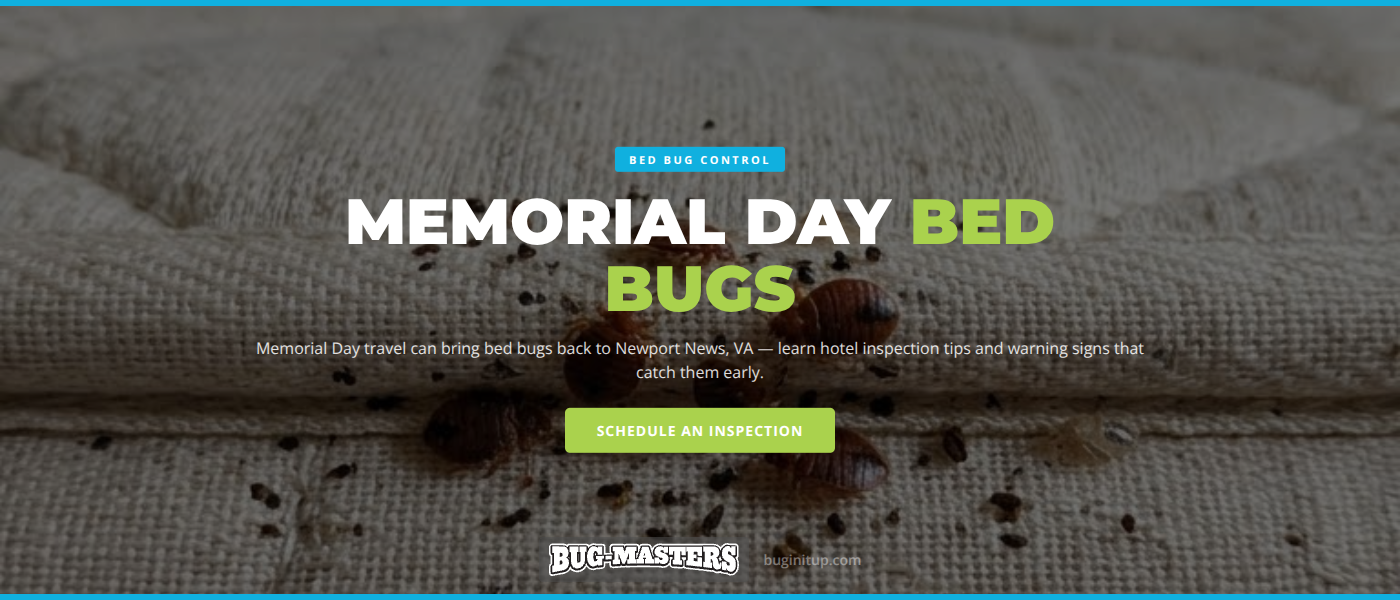
Memorial Day weekend is the unofficial start of summer in Hampton Roads, and for a lot of Newport News families it kicks off a season of beach trips, road trips, and weekends booked at hotels up and down the East Coast. We love seeing our community get out and travel, but at Bug-Masters we also know this is the same weekend every year when bed bug calls in Newport News start climbing. Travel is the single biggest way bed bugs move from one home to another, and a single overlooked stowaway on Memorial Day can turn into a full-blown infestation by the Fourth of July.
If you're heading out this weekend — or hosting relatives in from out of town — this guide walks through everything Newport News homeowners need to know about bed bug control in Newport News, VA: how they hitchhike, what they look like, how to inspect a hotel room, the early warning signs, and why DIY sprays almost always fail.
Bed bugs don't have a real "season" the way mosquitoes or termites do. They live indoors year-round and breed continuously when temperatures are comfortable. What changes in late May is us — our movement, our travel volume, and the number of beds we sleep in that aren't our own.
Memorial Day weekend triggers a measurable spike in hotel occupancy across coastal Virginia and the I-95 corridor. Hampton Roads sees an influx of visitors heading to Virginia Beach, Williamsburg, and the Outer Banks, and Newport News residents fan out across the Mid-Atlantic. Every stay is a chance for bed bugs to climb into a suitcase, a duffel, or a folded jacket and ride home.
We've watched the same pattern play out for years across our Newport News service area: a quiet April, a noticeable bump in inspection requests the week after Memorial Day, and a much bigger wave three to six weeks later when those initial hitchhikers have had time to breed.
Bed bugs cannot fly and cannot jump — they're slow crawlers, which is exactly why traveling is such a problem for them. According to Penn State Extension, "travelers can transport bed bugs back and forth in clothing, luggage, and laptop or tablet cases." That's the entire spread mechanism in one sentence.
Here's how it typically plays out for a Newport News family on a Memorial Day trip:
One female is all it takes. She can produce up to 500 eggs in her lifetime, which means a single Memorial Day hitchhiker is more than enough to start a real infestation by mid-summer.
Most people picture an adult bed bug — reddish-brown, flat, and roughly the size of an apple seed. That image is correct for adults, but it's only one stage of a six-stage life cycle, and the younger stages are what trip up most homeowners doing their own hotel inspection.
Every nymph stage requires a blood meal before molting into the next stage, and they shed their skins as they grow. Those shed exoskeletons — pale yellow, hollow, and roughly the shape of the bug — are one of the most common signs of an active infestation, even when you can't find a live bug. Per the EPA, eggs and shed skins are tiny "pale yellow skins that nymphs shed as they grow larger."
This is the single most useful skill you can take into Memorial Day weekend. A five-minute inspection before you put your bag down has stopped more infestations than every spray can on the shelf combined.
If you find anything — a live bug, a stain, a single egg — request a different room on a different floor and re-inspect. Don't accept the room next door, because bed bugs travel through wall voids and outlets between adjacent units. When you're satisfied the room is clean, keep your luggage on the rack pulled away from the wall, or on the tile. Don't put it on the bed, the upholstered bench, or the carpet.
Let's say the trip went great, but a few weeks later something feels off. Here's what to watch for, roughly in the order most homeowners notice them:
If you spot even one of the signs above, stop laundering the bedding (which can spread the bugs to other rooms) and get a professional inspection scheduled.
We get this call constantly: "I sprayed the bed, I bombed the room, I bought the powder from the hardware store — why are they back?"
Bed bugs have evolved alongside over-the-counter pesticides for decades. According to Penn State Extension, "aerosols and foggers have shown low efficacy against bed bugs," and relying on sprays alone "can lead to insecticide resistance." Three reasons DIY treatment fails almost every time:
This is why credible authorities recommend an integrated approach — mechanical methods (heat, steam, encasements, monitors) combined with targeted, professional-grade products applied where the bugs actually live.
If you've confirmed any signs above — or you just want peace of mind after a Memorial Day trip — this is when we step in. Our bed bug control in Newport News, VA starts with a thorough inspection by a technician who knows where to look. If bed bugs are present, we map the infestation, identify the harborages, and build a treatment plan around the specific situation in your home.
We combine targeted heat, steam, mechanical removal, encasements, and professional-grade product applications in cracks and voids the DIY can never reach. We follow up, we monitor, and we don't consider the job done until the bugs are gone and stay gone.
Bed bugs are not a hygiene problem and not a personal failing — they're a logistics problem, a hitchhiker that took advantage of a long weekend. The sooner you call, the smaller the problem stays. Learn more about our local Bed Bug Treatment program and reach out for a Newport News inspection.
Most Newport News homeowners notice the first signs three to six weeks after the trip. A pregnant female needs time to lay eggs, those eggs need 5 to 10 days to hatch, and nymphs need multiple blood meals before the population is large enough to leave obvious stains and shed skins.
Washing helps, but it's only part of the picture. We recommend washing travel clothes on the hottest setting the fabric will tolerate and drying on high heat for at least 30 minutes — heat is what kills bed bugs and eggs, not detergent. Your suitcase also needs attention: vacuum it, inspect the seams, and consider storing it in the garage or a sealed bag.
No. Bed bugs feed on blood, not crumbs or grime, and we treat infestations in spotless homes constantly. Clutter can make treatment harder because it creates more hiding places, but a clean home is not immune.
Faster than most people think. A single mated female can lay up to 5 eggs per day and around 500 eggs in her lifetime. Eggs hatch within a week or two at room temperature, and nymphs become reproducing adults in a few weeks under favorable conditions.
No. Bed bugs can survive over a year without feeding by slowing their metabolism. Closing off a guest room or moving to the couch just spreads the infestation to wherever you're sleeping now. Professional treatment is the only reliable way to get rid of an active infestation.
Memorial Day should be about the long weekend, the cookout, and the first real beach day of the year — not a months-long bed bug fight you didn't see coming. A few minutes of inspection up front and a quick call to us if anything looks off is all it takes to keep your Newport News home off the bed bug map this summer.