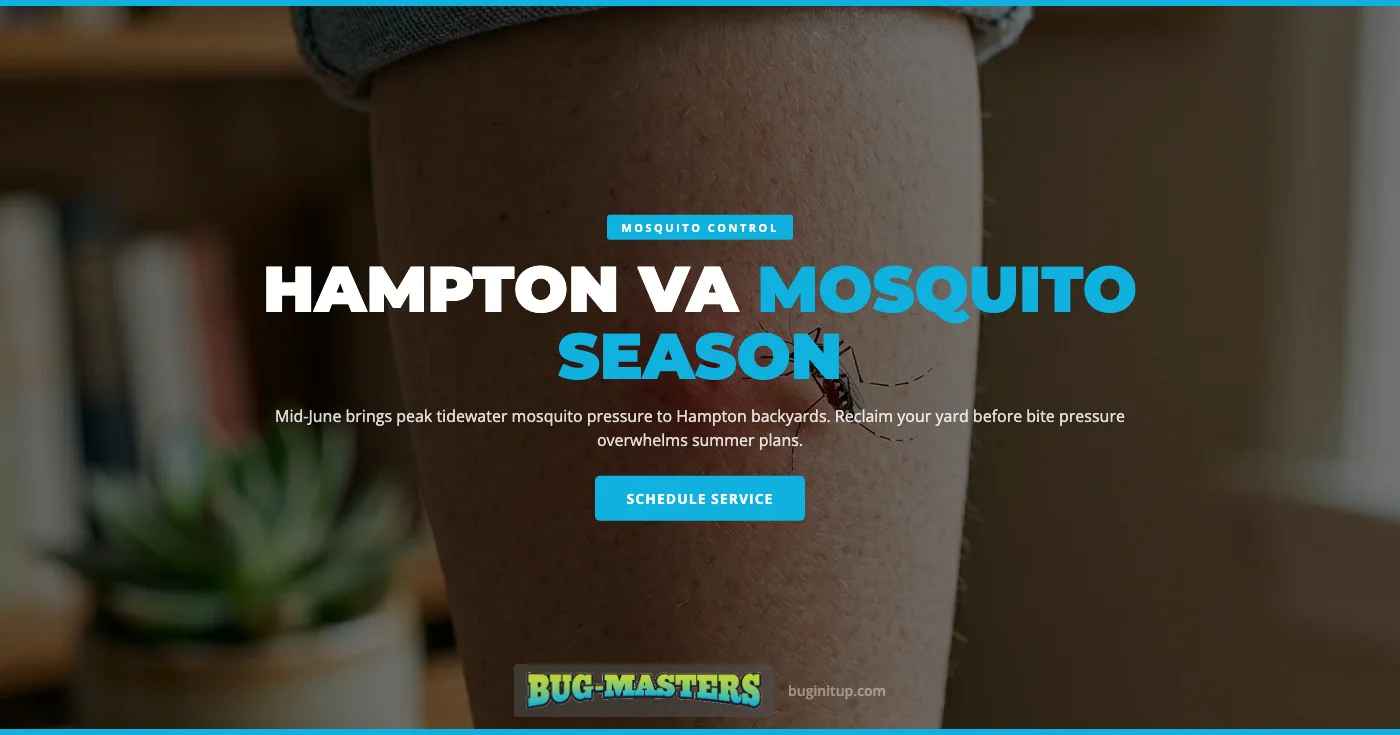
By mid-June, every Hampton homeowner has felt it — that first humid evening when the citronella candle is no match for what's swirling around the porch light. Mosquito activity in our corner of Virginia doesn't ramp up gradually; it explodes. Warmer nights, longer rains, and the salt marshes that border so much of our city create the ideal nursery for biting insects. At Bug Masters, we serve homeowners across Hampton and the wider tidewater region, and our service calls climb sharply this time of year. In this guide, we'll walk through why mosquito pressure peaks right now, where these insects are breeding in your backyard, and what professional mosquito control in Hampton, VA looks like when you're ready to take your evenings back.
Hampton sits squarely in one of the most mosquito-friendly corners of the East Coast. The city's environmental services division tracks roughly 35 species inside city limits, and surveillance traps consistently show populations climbing through April and May before peaking from June through September. Regional reporting has repeatedly named Hampton Roads among the worst mosquito hot spots in the country.
By mid-June, daytime highs in Hampton sit in the mid-80s, overnight lows stay above 65 degrees, and humidity rarely drops below 70 percent. Asian tiger mosquitoes — the aggressive daytime biter that arrived in the region in 1993 — can complete a full generation in seven to ten days under those conditions. A puddle that forms after a Tuesday thunderstorm can be producing biting adults by Friday. Add the lingering moisture from spring rains, and wave after wave of new mosquitoes hatch out at the same time the existing population is hitting reproductive maturity. That compounding effect is exactly why backyards go from manageable in late May to unusable by Father's Day weekend.
The "tidewater" label isn't just a regional nickname. Hampton sits at the mouth of three rivers — the James, the York, and the Back River — with the Chesapeake Bay forming the city's eastern edge. According to the City of Hampton's mosquito control program, more than 1,700 acres of salt marsh sit inside our city limits, and that single habitat produces close to half of every adult mosquito the city sees each summer.
When we talk about tidewater mosquito season, we're really describing four overlapping breeding environments working at once:
Each of these environments favors a different species, and that's the part most homeowners miss. Treating only one type does almost nothing about the others, which is why a well-rounded mosquito control plan in Hampton, VA has to account for every one of them.
When our technicians walk a Hampton property for the first time, we're not just looking at the lawn — we're looking at the things people stop noticing. Asian tiger mosquitoes only need about a bottle cap's worth of water to lay viable eggs, which means the breeding sites driving your yard's bite pressure are almost certainly sitting in plain sight. Here's where we find them most often:
The encouraging part: identify and eliminate these, and your bite pressure usually drops within a single mosquito generation.
We don't bring up disease risk to alarm anyone, but homeowners deserve the full picture before deciding how seriously to treat mosquitoes. The Virginia Department of Health identifies West Nile virus as the most common mosquito-borne disease in the state, and Hampton Roads has logged both human and equine cases. Regional surveillance traps have detected West Nile and Eastern equine encephalitis multiple summers running.
A few quick facts our customers ask about most:
Eliminating breeding sites and reducing the resting adult population around your home is the most effective way to protect your family and pets through the rest of the season.
We're big fans of DIY prevention — it's the foundation of any good mosquito control strategy in Hampton, VA, and the homeowner usually knows their own yard better than anyone. There are a few things you can do this week that genuinely move the needle:
What DIY alone can't solve is the steady migration of mosquitoes from neighboring properties, drainage ditches, marsh edges, and woodlots. That's where professional treatment earns its keep. A licensed mosquito service applies a targeted barrier treatment to the underside of foliage where adults rest during the day, treats standing water you can't drain with a biological larvicide that disrupts larvae without harming beneficial insects, and revisits the property on a schedule that matches each generation. Most of our Hampton customers see a 70 to 90 percent reduction in landing rates within the first 48 hours.
We've been treating yards across the Hampton Roads region for years, and our mosquito control process is built around the realities of tidewater pest pressure. Here's what a first visit looks like:
Our team is licensed by the Virginia Department of Agriculture and Consumer Services, and every product we use is selected with your family, pets, and the surrounding tidewater ecosystem in mind.
A single treatment can give you a good month, but homeowners who want their yards usable from May through October treat mosquito control as a season-long commitment. Over the years, we've found a few habits that turn occasional results into reliable ones:
That combination of professional treatment and smart landscape choices is what separates a yard you can use from one you avoid.
How long does a single mosquito treatment last in Hampton, VA?
Most barrier treatments hold their effectiveness for three to four weeks in our climate. Heavy rainfall can shorten that window, which is why our recurring service is set up on a 21-to-28-day cycle through the peak months.
Is mosquito treatment gentle around pets and kids?
We use products and application rates approved for residential properties, and we ask customers to keep pets and family indoors for about 30 minutes after treatment, until everything has dried. Once the application has settled, the treated areas are fine for normal outdoor use.
Why are mosquitoes so bad in Hampton, VA in June?
The combination of warm overnight temperatures, frequent rainfall, salt marsh breeding habitat, and short mosquito generation cycles means populations explode in early to mid-June. By the third week of the month, multiple generations are biting at the same time.
Do I need to treat my whole yard, or just the patio?
For meaningful relief, we treat resting sites across the entire property — not just the patio. Adult mosquitoes rest in foliage during the day and travel to bite, so treating only the patio leaves the source untouched.
What about the salt marsh next to my property?
We can't legally treat the marsh itself, but we can build a strong defensive perimeter on your side of the property line that intercepts mosquitoes moving inland from the wetland edge.
Mid-June is the moment Hampton homeowners decide whether the rest of the season is spent indoors or in the backyard. The mosquitoes already have a head start, but the right combination of source reduction and professional yard treatment can flip the script quickly. Our team has been protecting homes across Hampton and the wider tidewater region for years. If you're ready to take back your evenings, learn more about our Mosquito Control service or get in touch with us today.