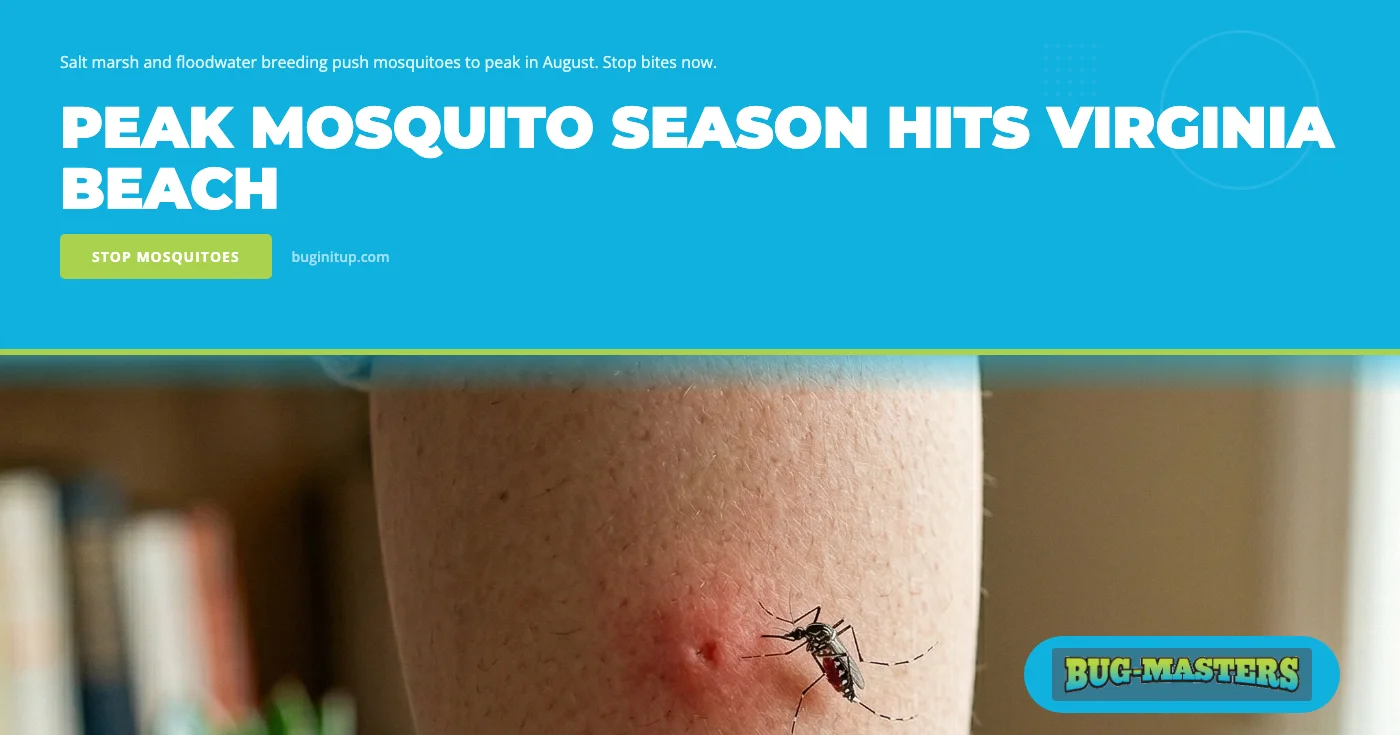
Why August Is Peak Mosquito Season in Virginia Beach, VA: Salt Marsh and Floodwater Breeding After Summer Storms
If you have tried to enjoy a backyard cookout in Virginia Beach this month, you already know what the calendar confirms: August is the height of mosquito season on the Virginia coast. The bites are relentless, the evenings feel unusable, and the swarms seem to reappear within days of every summer storm. At Bug-Masters, our phones ring the most during late summer, and the reason is no mystery. Virginia Beach sits at the meeting point of tidal salt marsh, warm Atlantic humidity, and a steady parade of coastal storms — a combination that turns August into the busiest breeding stretch of the entire year. In this guide, we will explain why mosquito pressure peaks right now, where these insects are hatching across Hampton Roads, and what effective mosquito control in Virginia Beach, VA actually involves.
Why Mosquitoes Peak in Virginia Beach During August
Mosquito season in coastal Virginia stretches from roughly April through October, but the biting rarely feels worse than it does in August. Early-season mosquitoes in April and May are only a preview; by late summer, the region is running at full capacity. Several forces converge at once. Daytime highs hold in the upper 80s, overnight lows stay in the 70s, and the humidity that rolls off the Chesapeake Bay and the Atlantic rarely lets up. Mosquitoes are cold-blooded, and that sustained warmth lets each generation develop faster and lay more eggs than it could earlier in the year.
August also carries the accumulated weight of every brood that came before it. The mosquitoes hatching now are the descendants of populations that have been building since spring, and they are emerging on top of one another rather than in neat, separated waves. Layer in the standing water left behind by summer thunderstorms and tropical systems, and Virginia Beach yards can go from tolerable in June to genuinely unbearable by the middle of August. This compounding effect is why regional surveys have repeatedly ranked Hampton Roads among the worst mosquito hot spots in the country, and why the peak biting window here runs from July straight through September — often lingering into October whenever the weather stays warm.
How Salt Marshes and Tidal Flooding Fuel Coastal Mosquito Breeding
The single biggest reason Virginia Beach struggles with mosquitoes is geography. Our city is wrapped in tidal salt marsh — from the wetlands along the Lynnhaven River to the vast expanse of Back Bay and the marshes bordering the Chesapeake Bay. That habitat is the natural nursery of the eastern saltmarsh mosquito, Aedes sollicitans, one of the most abundant and aggressive biters anywhere on the Atlantic coast.
What makes this species so difficult is the way it exploits the tides. According to the Rutgers Center for Vector Biology, female saltmarsh mosquitoes lay their eggs individually on moist soil in the upper reaches of the marsh — ground that sits just above the daily tide line. Those eggs dry out and wait, sometimes for weeks. When an exceptional high tide, a spring tide, or a heavy rain finally floods those shallow depressions, the eggs hatch all at once, and the larvae can develop into biting adults in as little as four to five days.
Just as important is how far these mosquitoes travel. Saltmarsh broods routinely disperse several miles inland from the marsh where they hatched. That means you do not need to live on the water to be overwhelmed by them — a home well inside Virginia Beach, or over in Norfolk and Chesapeake, can be blanketed by mosquitoes born in a marsh miles away. It also explains why draining the standing water in your own yard, while genuinely important, never tells the whole story here on the coast.
The Role of Summer Storms and Standing Water in Your Yard
Virginia Beach sits squarely in the hurricane and tropical-storm corridor of the mid-Atlantic, and August marks the ramp-up of that season. Every heavy downpour, coastal storm, or passing tropical system drops water across the entire region at once — and mosquitoes are built to capitalize on it. After a major rain event, floodwater species can explode in number within a single week, which is why the days following an August storm are so often the worst mosquito stretch of the entire year.
The marsh absorbs the large-scale flooding, but your own property collects its share of storm water in spots that are easy to overlook. In the days after a storm, the breeding sites we find most often around Virginia Beach homes include:
- Clogged gutters and downspouts that overflow and trap standing water long after the rain has stopped.
- Tarps and covers over grills, boats, firewood, and patio furniture, where every sagging fold holds a pool.
- Corrugated drain extenders — the black accordion pipes that never fully drain between their ridges.
- Low spots and French drains in the yard where runoff lingers for days on already saturated coastal soil.
- Pool covers, kiddie pools, and boat covers, which are especially common along our waterways and canals.
- Buckets, plant saucers, and toys left out during the storm and forgotten once the sun returns.
A container no larger than a bottle cap can produce mosquitoes, so the cumulative effect of one storm passing through a neighborhood is enormous. Walking your property the day after heavy rain and tipping out anything holding water is one of the single most effective things a Virginia Beach homeowner can do.
Common Mosquito Species in the Hampton Roads Area
Not all mosquitoes behave the same way, and Virginia Beach contends with several at once. Knowing which is which matters, because each one breeds in a different place and bites at a different time of day:
- Eastern saltmarsh mosquito (Aedes sollicitans). The storm-and-tide breeder described above. It is a powerful flier, a persistent daytime and dusk biter, and the species most responsible for the sudden swarms that follow high tides and heavy rain.
- Asian tiger mosquito (Aedes albopictus). A container specialist that breeds in the small pockets of water around your home. It is a daytime, ankle-level biter that has become firmly established across Hampton Roads.
- Northern house mosquito (Culex pipiens). Most active at dusk and dawn, this species breeds in stagnant, organically rich water such as catch basins, storm drains, and neglected containers. It is the primary carrier of West Nile virus in our region.
Because these species hatch in such different places — open tidal marsh, backyard containers, and stagnant drains — no single tactic brings all of them under control. That is the core reason do-it-yourself efforts so often fall short in Virginia Beach, and why a well-rounded program has to account for every one of them.
Health Risks: West Nile and Other Mosquito-Borne Illnesses in Coastal Virginia
Mosquitoes are more than a nuisance in coastal Virginia. West Nile virus is the most common mosquito-borne illness in the state, and it is carried chiefly by the Culex mosquitoes that thrive in late summer. Mosquitoes testing positive for West Nile are found across Hampton Roads on a regular basis, and detections tend to climb through August and September — exactly when Culex populations reach their seasonal peak.
Most people infected with West Nile never feel ill, and only a small share develop a fever or, more rarely, a serious illness affecting the nervous system. The risk is real enough to take seriously, though, particularly for older adults and anyone with a weakened immune system. Cutting down the number of bites your household takes during peak season is a meaningful step toward protecting everyone's well-being.
West Nile is not the only concern. The eastern saltmarsh mosquito can transmit eastern equine encephalitis, a rare but severe illness, and several kinds of mosquitoes spread heartworm to dogs and cats. None of this should keep your family indoors all summer — but it is a strong reason to keep mosquito numbers down around your Virginia Beach home rather than simply tolerating them until fall.
How to Reduce Mosquito Breeding Sites Around Your Virginia Beach Home
Source reduction — removing the standing water where mosquitoes lay their eggs — is the foundation of every effective control program, and it is a point the U.S. Environmental Protection Agency stresses as the first line of defense. The habits that make the biggest difference in Virginia Beach are simple, but they need to stay consistent, especially after storms:
- Walk your yard weekly — and again the day after any heavy rain — tipping out every container holding water.
- Keep gutters clean so they drain fully instead of holding a shallow pool all summer long.
- Refresh bird baths and pet bowls every three to five days to interrupt the breeding cycle before larvae mature.
- Store or cover buckets, wheelbarrows, toys, and tarps so they cannot collect the next round of rainwater.
- Screen rain barrels and treat ornamental ponds or water features that cannot be drained.
- Trim dense shrubs and tall grass where adult mosquitoes rest and shelter during the heat of the day.
These steps meaningfully reduce the container-breeding mosquitoes born on your own property. What they cannot do is stop the saltmarsh broods that fly in from miles of tidal wetland after every high tide and storm. That gap — between what a homeowner can manage and what the coastal landscape keeps producing — is exactly where professional mosquito control in Virginia Beach, VA earns its keep.
How Bug-Masters Controls Mosquitoes in Virginia Beach
When our technicians arrive at a Virginia Beach property, we begin with a thorough inspection rather than a blanket spray. We look for the breeding sites feeding your yard's bite pressure and the shaded harborage — dense shrubs, low foliage, and damp ground cover — where adult mosquitoes wait out the daytime heat. Understanding both where they hatch and where they rest is what makes treatment effective instead of merely temporary.
From there, our Mosquito Control service combines several complementary tools: larvicide for standing water that cannot be drained, targeted treatment of the resting sites where adults gather, and a recurring seasonal schedule that keeps pressure down as new broods hatch. That recurring piece matters enormously on the coast, because every high tide and every August storm re-seeds the marsh and restarts the cycle. A single treatment cannot hold back a landscape that keeps producing mosquitoes all season — which is why we build ongoing programs rather than promising a one-time fix or a mosquito-free guarantee that no honest company can make.
Late summer is also when other pests surge across Hampton Roads, from ants and roaches to the rodents that begin seeking shelter as the season turns. Our broader General Pest Control service covers those alongside your mosquito program, so your home is protected on more than one front. We are proud to serve Virginia Beach along with Norfolk, Chesapeake, Portsmouth, Suffolk, Hampton, and Newport News.
If August has made your yard unusable, you do not have to wait out the season. Reach out to Bug-Masters, and let us help you take your Virginia Beach evenings back — this month and through the rest of a long coastal mosquito season.