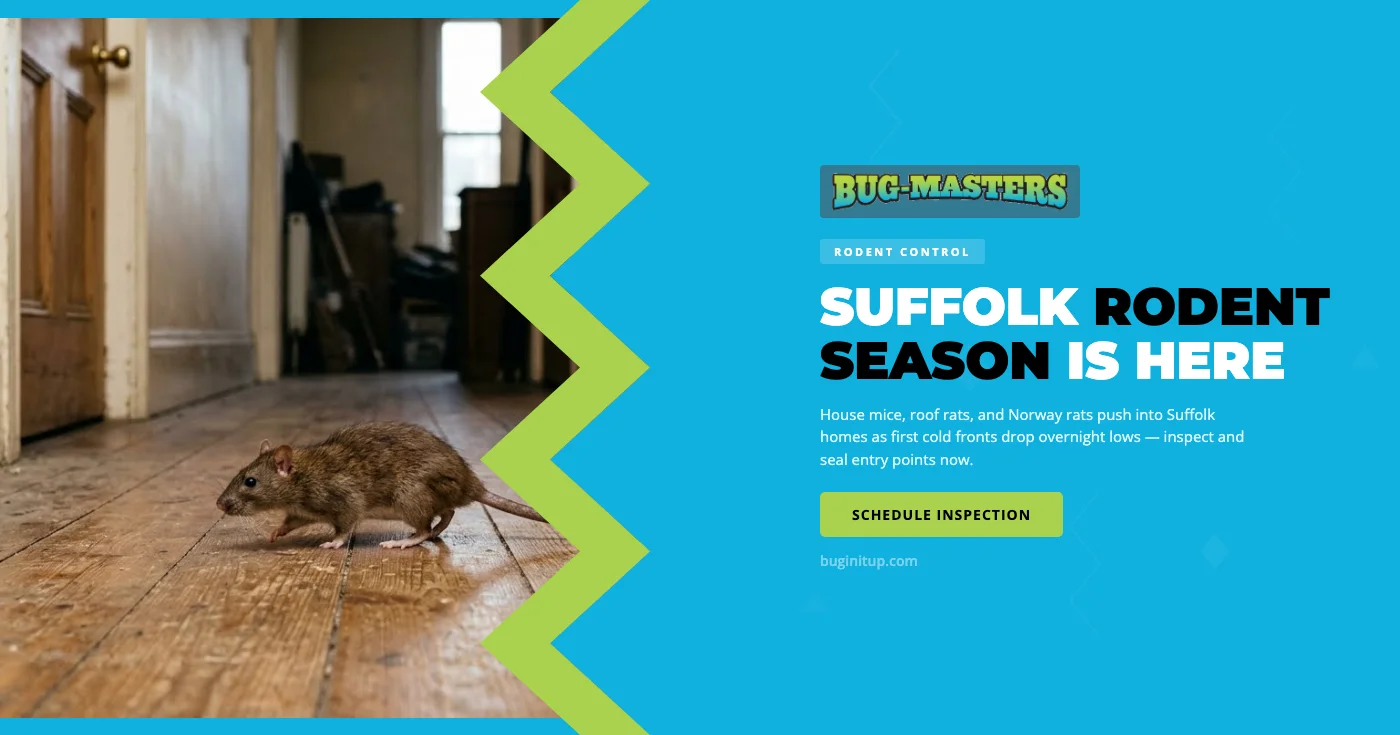
Every year around the second week of September, the phones at Bug-Masters start ringing with a familiar cluster of calls from Suffolk homeowners: scratching in the walls at 2 am, droppings on the pantry shelf, a scampering shadow across the garage floor. The trigger is not the calendar — it is the first stretch of nights in the mid-50s that Suffolk, VA typically sees between late September and mid-October. Cooler nights, the end of outdoor breeding, and the collapse of the wild food supply push mice and rats hard toward the closest warm, dry building with something to eat. Understanding what drives the fall invasion, where they get in, and what actually works to stop them is what most Suffolk homeowners need to know before rodent control in Suffolk, VA becomes a January emergency call instead of an October prevention step.
Why Fall Is Prime Rodent Season in Suffolk, VA
Fall is not when rodents appear in Suffolk — it is when they move. Populations have been building all spring and summer in fields, woodlots, marshes, and behind sheds. What changes in September and October is the balance between "outside is fine" and "inside is better." Four seasonal forces stack up in Suffolk during this window and drive the entire fall infestation cycle.
Nighttime temperatures. Rodent indoor pressure climbs sharply once overnight lows drop below roughly 50°F — a threshold Suffolk typically crosses for the first time in late September and consistently by mid-October. House mice do not hibernate; they seek warmth, and a heated crawlspace, attic, or wall void is dramatically more inviting than a wet leaf pile at 42 degrees.
Wild food collapse. Through summer, rodents in Suffolk's rural corridors — from Whaleyville and Holland out to Chuckatuck and the edges of the Great Dismal Swamp — eat seeds, insects, berries, and garden overflow. By late September that supply crashes: row crops come off the fields, garden production ends, and insect populations die back. Rodents follow the food to the next reliable source — often a garage full of birdseed, a shed with dry dog food, or an unsecured kitchen.
End of the breeding season. A single female house mouse can produce five to ten litters in a season, and a Norway rat pair can generate 40 or more young in a year. By September, populations across coastal Virginia are at peak size — every wandering juvenile is looking for its own territory, and the closest structure with a foothold gap wins.
First cold-front migration. The first serious cold front — usually the one that pushes daytime highs into the 60s for a stretch — triggers a distinct wave of rodent movement across Hampton Roads. Homeowners who saw no evidence in August often find droppings, chew marks, or a nest within two weeks of that front.
How Mice and Rats Enter Suffolk Homes When Temperatures Drop
Rodents do not force their way into Suffolk houses — they walk in through gaps that were already there. What makes fall different is the intensity of the search. A gap a mouse walked past in July becomes a doorway in October. According to the Virginia Department of Wildlife Resources, house mice "have been introduced worldwide with humans" and thrive around structures precisely because they exploit the small openings human construction leaves behind.
The size threshold is smaller than most homeowners think. A house mouse can squeeze through an opening the size of a dime — roughly ¼ inch. A juvenile Norway rat needs only about ½ inch, and an adult roof rat can compress its body through a hole the size of a quarter. If you can slide a pencil into a gap, a mouse can get through it.
The exterior entry points we find over and over in Suffolk homes. Every fall inspection turns up the same short list of chronic weak points:
- Worn or missing door sweeps on garage side doors, front doors, and back doors — the single most common ground-level entry across Suffolk neighborhoods
- Crawlspace vent screens torn or rusted through, especially on older homes in downtown Suffolk and Hobson
- Dryer vent hoods with broken or missing flaps
- Gaps around utility penetrations where water lines, gas lines, cable, and refrigerant lines enter the exterior wall — rodents chew through spray foam readily
- Weep holes in brick veneer without stainless steel guards
- Gable vents, ridge vents, and roof-line gaps for roof rats, which climb siding, downspouts, and mature trees to reach eaves
- Foundation cracks and settling gaps at the sill plate, common in the older housing stock in Whaleyville and along the Nansemond River
Two species, two entry styles. Norway rats are ground-level burrowers — they dig against foundations, enter at the sill plate, and colonize crawlspaces and basements. Roof rats and house mice are climbers — they move up siding, into soffits and attics, and drop into wall cavities from above. Suffolk homes typically get both, but the entry-point priorities are different depending on which species is pressing hardest that year.
Warning Signs of a Rodent Problem in Your Suffolk Home
Most Suffolk homeowners do not see a rodent before they see the evidence. Mice and rats are largely nocturnal and prefer to travel along walls, under floors, and inside voids. By the time you spot a live one in daylight, the population inside your home is well established. The early warning signs are subtle but consistent.
- Droppings. House mouse droppings are dark, rice-grain shaped, and ⅛ to ¼ inch long. Norway rat droppings are larger — up to ¾ inch — with blunt ends. Roof rat droppings taper to points at both ends. You will find them first along baseboards, behind the range, under the sink, in pantry corners, in the garage, and on top of ductwork in the crawlspace.
- Scratching or scurrying in walls and ceilings at night. Peak activity runs from roughly 30 minutes after sunset through the early morning hours. Rodents in wall voids sound like a small hand brushing against drywall from the other side.
- Gnaw marks. Fresh gnaw marks are pale and light-colored; old marks darken with age. Look on wood trim around garage door frames, on cardboard boxes in storage, on plastic food containers in the pantry, and around utility penetrations under sinks.
- Greasy rub marks. Rodents run the same routes repeatedly and their fur leaves a dark, oily smudge along walls, floor joists, pipe runs, and doorway edges. Rub marks are one of the clearest indicators of an established population.
- Nests. Shredded insulation, chewed cardboard, tissue, dryer lint, or fabric compacted into a loose ball — commonly found in storage bins, behind large appliances, in attic corners, and inside disused HVAC returns.
- Ammonia smell. A persistent urine odor in a closet, pantry, or crawlspace is almost always a rodent population, not humidity or a plumbing issue.
- Pet behavior changes. Dogs and cats fixating on a specific baseboard, closet corner, or floor register are frequently the first alert a Suffolk homeowner gets before physical evidence shows up.
DIY Rodent Prevention Tips Every Suffolk Homeowner Should Try
Plenty of meaningful fall rodent work does not require a professional. Before — or alongside — a service call, here is what we recommend every Suffolk homeowner do during September and October.
- Do an exterior walk with a flashlight and a pencil. Circle the house slowly. Anywhere you can slide the pencil into a gap, a mouse can get through. Mark every gap with painter's tape and come back with materials.
- Seal with durable materials. Rodents chew through spray foam, caulk, and steel wool alone within weeks. The combination that lasts is coarse steel wool or copper mesh stuffed tight, then sealed over with silicone. For gaps larger than ½ inch, use ¼-inch galvanized hardware cloth as the base.
- Replace worn door sweeps. The rubber sweep on garage side doors and exterior entry doors is the single highest-value fix. A ½-inch daylight gap under a door is a rodent highway. Replacements run under $20 and take 15 minutes.
- Screen the vents. Cover crawlspace vents, dryer vent hoods, and gable vents with ¼-inch galvanized hardware cloth. Standard fiberglass window screen does not stop mice.
- Move food out of reach. Transfer pet food, birdseed, dry goods, and grass seed from paper or plastic bags into hard sealed containers. Never leave pet food out overnight, especially in the garage.
- Cut the exterior food supply. Bring bird feeders in overnight or move them 30 feet from the house. Pick up fallen fruit and pet waste. Keep trash bins tightly lidded.
- Trim vegetation back from the house. Aim for 3 feet of clearance between shrubs and siding, and keep tree branches at least 6 feet off the roofline — roof rats use branches as bridges to soffit and gable-vent entry points.
- Set snap traps early. If you see any evidence — droppings, gnaw marks, one sighting — set half a dozen snap traps immediately along baseboards where droppings appear, in the garage, and in the crawlspace or attic if accessible. Peanut butter is more effective bait than cheese.
Why Professional Rodent Control Is the Most Effective Solution
DIY steps handle a small, early-stage rodent problem in most Suffolk homes. What DIY does not handle well is an established population, a repeat annual infestation, or a home where the entry points are not visible from the outside. The reasons professional rodent control in Suffolk, VA outperforms a DIY effort in the fall are practical and specific.
Population math. By the time visible signs appear, a house mouse population inside a Suffolk home is often 15 to 25 individuals — sometimes more. Snap traps and store-bought bait blocks reduce the numbers but rarely finish the job, because surviving females continue breeding through the winter indoors. A structured trap-and-bait program with weekly monitoring is what actually collapses the population.
Entry-point mapping. Most rodent entries in Suffolk homes are in places a homeowner will never think to look — inside a crawlspace at the corner where the sill plate meets a settling foundation, on top of an attic gable vent behind blown insulation, along a plumbing chase inside a wall cavity. Professional inspections use headlamps, moisture meters, and thermal imaging to find the entries a flashlight walk-around cannot.
Health exposure. Rodent droppings and urine carry pathogens, and dried droppings that get vacuumed or swept can aerosolize particles. Hantavirus is rare in coastal Virginia but not zero, and salmonella, leptospirosis, and rat-bite fever are all documented rodent-associated illnesses. Professional cleanup uses HEPA-filtered vacuums and appropriate disinfection protocols instead of a household broom.
Ongoing prevention. A single treatment addresses the current population. A quarterly service cadence — which is what most Suffolk homes settle into after a first serious rodent event — keeps the population from re-establishing when next fall's cold fronts arrive. According to the Virginia Department of Wildlife Resources, Norway rats "form colonies of a few to several hundred individuals" and reproduce year-round in favorable conditions — meaning once a Suffolk home becomes hospitable, it stays hospitable unless the underlying conditions change.
How Bug Masters Protects Suffolk, VA Homes From Fall Rodent Invasions
Our fall rodent control program for Suffolk, VA homes starts with a full-structure inspection — exterior, interior, garage, crawlspace, and attic. We identify the species pressing on the home, map every active and potential entry point, and locate the runways, nesting sites, and droppings that reveal where the population lives inside the structure. That inspection drives everything else.
From there we build a Suffolk-specific treatment plan. Exclusion work seals identified entry points with the right materials for each opening — copper mesh and silicone at utility penetrations, ¼-inch galvanized hardware cloth over vents, replacement door sweeps at ground-level gaps, and sealed collars around plumbing chases in the crawlspace. Trapping and bait station placement is done in the runways and nesting areas we identified rather than in the visible spots where most homeowners set their own traps. Follow-up visits confirm the population has collapsed, adjust placements based on activity, and add exclusion where we find additional pressure.
Bug-Masters serves the full Suffolk service area along with Virginia Beach, Norfolk, Chesapeake, Portsmouth, Hampton, and Newport News. Our broader pest services address the seasonal patterns specific to coastal Virginia — the same fall cooldown that pushes rodents inside is also driving stink bugs, cluster flies, and overwintering ants toward the same warm harborages. Handling the whole picture in one service program is usually more effective and less expensive than chasing each species with a separate call.
Frequently Asked Questions
When does fall rodent season actually start in Suffolk, VA?
The first meaningful indoor pressure typically begins the last week of September, when overnight lows in Suffolk start dropping into the mid-50s. Activity peaks through October and stays elevated into November. Homeowners who wait for cold weather to schedule prevention are usually already in remediation mode by mid-October.
What is the difference between mice and rats in a Suffolk home?
House mice are small (adults 5 to 7 inches including tail), lightweight, and prefer wall voids, cabinet corners, and pantries. Norway rats are much larger (12 to 18 inches nose to tail-tip), heavier, and prefer ground-level spaces — crawlspaces, basements, and burrows against foundations. Roof rats are somewhere in between, prefer overhead spaces, and are strong climbers. Signs, droppings, and treatment strategy all differ by species, which is why identification matters at the start of any rodent program.
Can I get rid of mice in my Suffolk home myself, or do I need a professional?
A very early, very small infestation — one or two sightings, minimal droppings, one obvious entry point — often responds to a diligent DIY effort with proper materials and snap traps. Once you have droppings in multiple rooms, scratching in the walls, or a repeat annual problem, professional rodent control in Suffolk, VA collapses the population faster and more reliably than DIY, and identifies the hidden entries that keep the problem coming back.
How much does professional rodent control in Suffolk, VA typically cost?
Cost depends on the size of the home, severity of the infestation, and how much exclusion work is needed. Full-structure exclusion on a large home costs more than a small mouse problem in one wall void, so we provide a written quote after the initial inspection — no surprises, and a discounted quarterly maintenance cadence afterward once the initial population is cleared.
Fall in Suffolk is when rodents move — and the homes that stay ahead of the season are the ones that get inspected, sealed, and monitored before the first cold front rather than after the first droppings show up on the pantry shelf. If you are already seeing signs, or your home has a history of fall rodent activity, reach out to Bug-Masters. Helping Hampton Roads families take their homes back from fall rodent pressure is the work we are here to do.