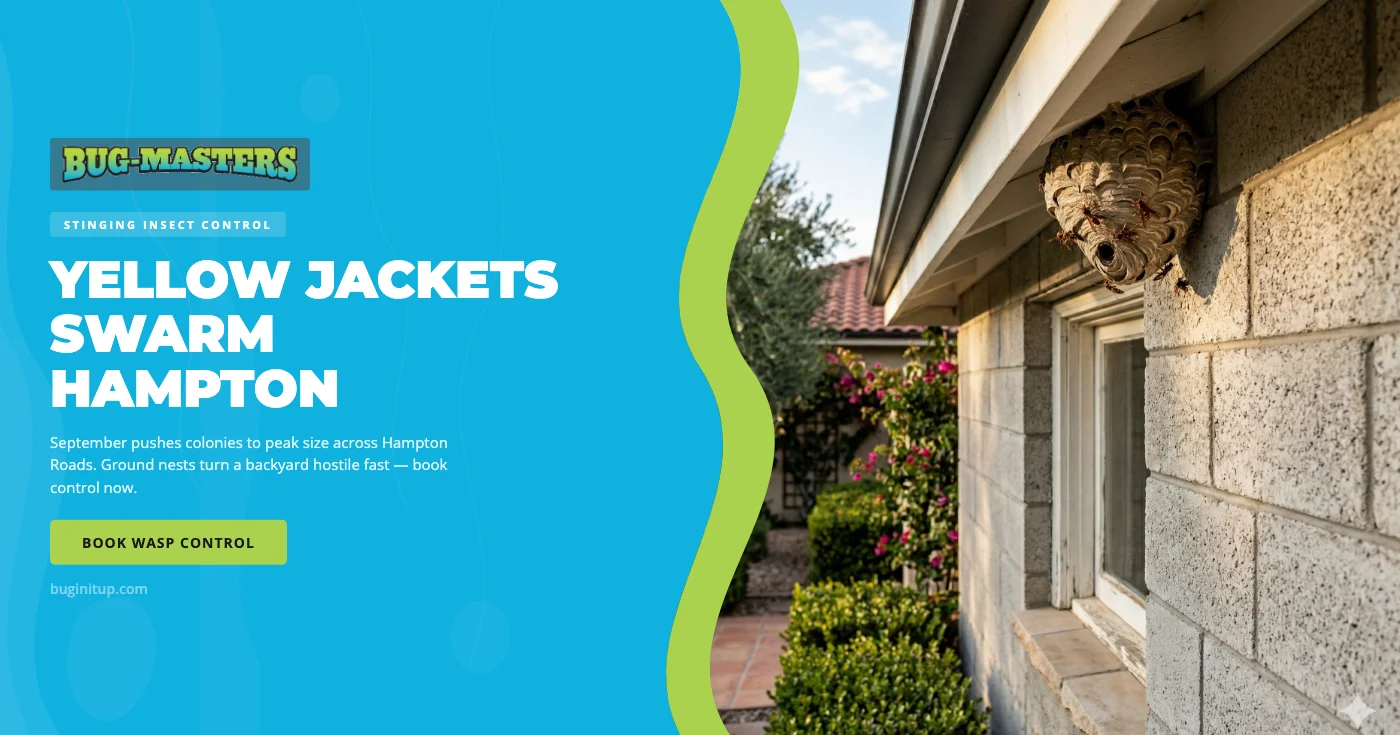
By the time Labor Day passes and the first cool nights start rolling into Hampton, the wasps and yellow jackets we've been treating quietly all summer suddenly turn into the ones that make homeowners call in a panic. A grandmother in Wythe reaches for a hose bib and gets stung four times before she sees the ground nest. A landscaper working a Buckroe lawn hits an in-ground colony with a string trimmer and takes eight stings running for his truck. From the second week of September through mid-October, every stinging insect nest that started with a lone queen back in April is at its yearly peak — and the workers defending it are as aggressive as they will be all year.
Effective yellow jacket removal in Hampton, VA starts with understanding what changes inside those nests in early fall. At Bug-Masters, we've spent decades treating wasps, hornets, and yellow jackets across Hampton and greater Hampton Roads, and September is consistently our highest-volume month for stinging insect calls. This guide walks through why that is, where these nests hide on local properties, how to tell one species from another, and what actually works to protect your family before someone gets hurt.
Every yellow jacket, hornet, and paper wasp nest you see in Hampton started with a single fertilized queen that overwintered from last fall. According to Virginia Cooperative Extension, those queens emerge in April, build a starter comb the size of a walnut, and lay the first batch of eggs alone. The first workers hatch in May and June, and the colony roughly doubles every two weeks through the summer.
Hampton's Tidewater climate stretches that cycle to its outer limit. Warm, humid summers shorten brood development, and mild coastal winters push more queens through to spring. The colony a homeowner walked past in June — thirty workers, no traffic worth noticing — carries several hundred workers by early August and can top three to five thousand by mid-September. Eastern yellow jacket colonies in coastal Virginia routinely reach that size, and larger German yellow jacket colonies in wall voids sometimes push higher.
Three seasonal forces converge in Hampton during this window and drive the peak:
The result across Hampton is the pattern we see every year: calls that trickle in through July become a wave in September as homeowners discover ground nests, wall-void colonies, and aerial hornet nests they walked past for months without noticing.
Hampton properties offer stinging insects nearly perfect conditions: warm humid summers, wooded lots along the Back River and Newmarket Creek, mixed siding across older Wythe and Phoebus neighborhoods, and hundreds of quiet cavities on every block. The nests we find most often on local properties live in:
The tell for a hidden nest is always the same — a steady, one-way stream of workers flying in and out of a single opening. Foraging wasps do not repeat the same flight path; nest workers do. Watch a suspicious spot for two minutes on a warm afternoon, and if the traffic never stops, you've found the entrance, even if the colony sits ten feet inside a wall.
Not every stinging insect on a Hampton property warrants the same response, and treatment strategy is different for each species. Here is what we actually find across local properties from September through October:
Identifying the species is the first thing we do on any Hampton property. Treatment for a bald-faced hornet nest in a tree crown is not the same as treatment for a yellow jacket colony in a wall void, and a paper wasp comb under an eave does not need the same intervention as an aggressive in-ground yellow jacket nest along a walkway.
Homeowners who tolerated a distant nest through July are often astonished at how much bolder the same wasps become in September. The behavior shift is real, well documented, and driven by biology rather than mood.
According to the Clemson Home and Garden Information Center, yellow jacket colonies reach maximum size in late summer and early fall, then face collapsing food supplies as the queen stops producing brood. Three things change at once:
The larval sugar supply ends. Through the summer, worker yellow jackets feed protein to developing larvae and receive a sugary secretion in return — a symbiotic exchange that keeps the colony fed. When the queen stops laying and no new larvae are produced, that sugar tap shuts off. Suddenly-hungry workers turn hard toward any outdoor sugar source, which is why September wasps become the ones swarming your soda can, hummingbird feeder, and open trash bin.
Colony population is at yearly maximum. A spring nest that could put twenty defenders in the air can now put a thousand. Any disturbance — a lawn mower, a foot near a burrow entrance, a rake in a mulch bed — pulls a defensive response many times larger than the same disturbance would have provoked in June.
The colony is defending its end-of-season investment. By September, the colony is producing next year's queens and males. Workers are hard-wired to defend that reproductive investment at any cost. Every alert-pheromone burst that triggers one worker to sting draws dozens more in a fraction of a second.
Fall yellow jacket stings in Hampton reach the ER far more often than summer ones for exactly these reasons. A single September ground nest disturbed at the wrong moment can put five to fifteen stings on one person before they can back away.
We understand the impulse — a spray can from the hardware store looks cheap, and the internet is full of videos of people knocking down paper wasp combs with a broom. What the videos leave out is the difference between a small, exposed paper wasp comb in June and a mature in-ground yellow jacket colony in September. The risks of DIY removal at this time of year are not theoretical:
Every fall we get calls from Hampton homeowners who tried a hardware-store spray on a September nest and are now dealing with a much angrier colony, sometimes plus stings that required an urgent care visit. Save the effort — and the risk — for problems where DIY actually works.
If you spot an active wasp or yellow jacket nest on your Hampton property this fall, the right sequence of steps protects your family while we get out to treat it:
Photos or short videos taken from well back — twenty feet or more — help us prepare the right equipment and treatment approach before we arrive.
Our fall wasp and yellow jacket removal service in Hampton starts with a full inspection to identify the species, locate the colony entrance, and evaluate the surrounding property for secondary nests. That inspection determines the treatment method.
Ground-nesting yellow jacket colonies get direct treatment at the burrow entrance with a targeted product that penetrates the full nest chamber, followed by monitoring to confirm the colony has collapsed. Wall-void colonies get a dust-based treatment applied through the entry point so workers carry the material back into the nest, killing the colony from within without opening the wall. Aerial hornet and paper wasp nests get direct knockdown treatment followed by physical removal once the workers are dead.
Every treatment is followed up with an exterior perimeter application that reduces re-establishment pressure through the remainder of the season. We also seal identified entry points on structural nests to keep next year's overwintering queens from moving back into the same cavity in April.
Bug-Masters serves the full Hampton service area along with Virginia Beach, Norfolk, Chesapeake, Portsmouth, Suffolk, and Newport News. Our broader general pest control program addresses the seasonal patterns specific to coastal Virginia — the same fall wind-down that pushes yellow jackets to peak defensiveness is also driving stink bugs, overwintering ants, and cluster flies toward warm harborages in the same homes. Handling the whole picture in one program is usually more effective and less expensive than chasing each species with a separate call.
Peak activity runs from mid-September through mid-October in Hampton. Workers begin dying off with the first hard frost — typically late October to early November on the Virginia Peninsula, though mild years can push activity into Thanksgiving week. Most yellow jacket colonies are effectively gone by December, but the fertilized queens that overwinter in wall voids, attics, and mulch beds will start new colonies the following April.
For a small paper wasp comb far from foot traffic, sometimes yes. For a ground-nesting yellow jacket colony along a walkway, a wall-void colony in a bedroom wall, or a bald-faced hornet nest over a patio, waiting six to ten weeks for frost means six to ten weeks of active stinging risk during the most defensive period of the year. Professional yellow jacket removal in Hampton, VA collapses the colony within a day and eliminates the exposure window.
Both inject venom, both hurt, and both can trigger allergic reactions. The key differences: honeybees leave a barbed stinger and can only sting once, while yellow jackets, hornets, and wasps have smooth stingers and can sting repeatedly. Yellow jackets and hornets also release alarm pheromones that recruit nestmates to the sting site, which is why a single provocation can turn into ten or fifteen stings in seconds.
Cost depends on the species, location, and accessibility of the nest. A single paper wasp comb under an eave is straightforward and inexpensive. A large in-ground yellow jacket colony or a wall-void nest that requires dust treatment plus follow-up runs higher. We provide a written quote after inspecting the nest, and quarterly maintenance service afterward comes at a discounted rate for homeowners who want ongoing pest coverage.
September in Hampton is when yellow jackets are at their most dangerous, and it is also when a professional treatment produces the biggest payoff — one call collapses a nest that could otherwise generate weeks of stings and hundreds of dollars in urgent care bills. If you have spotted an active nest, or your property has a history of fall stinging insect activity, reach out to Bug-Masters. Protecting Hampton Roads families from peak-season yellow jackets and wasps is exactly the work we are here to do.