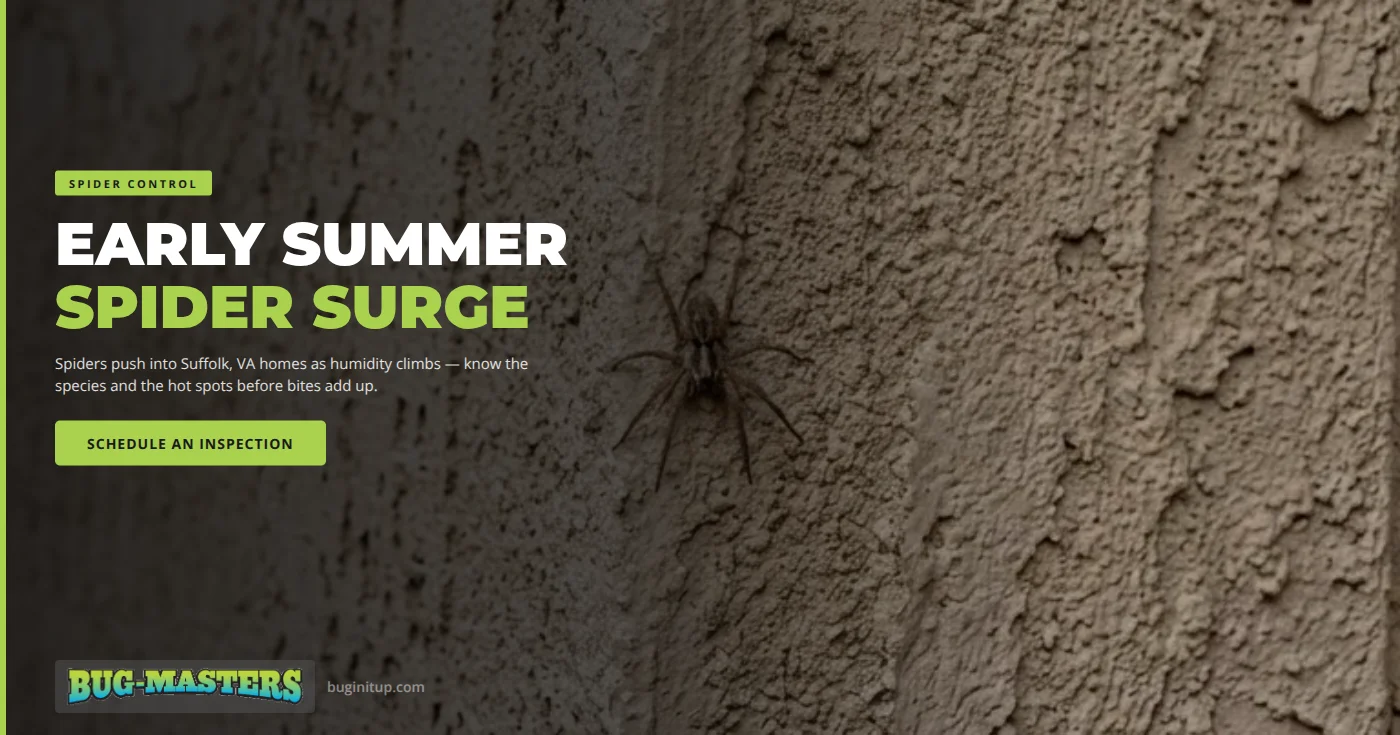
Every year around the first week of June, the spider calls start rolling in across Suffolk. A wolf spider darting across the kitchen floor at 11pm. A fresh web stretched across the back porch overnight. Egg sacs tucked into a shed corner. It isn't your imagination — spider activity inside Hampton Roads homes spikes sharply in early summer, and at Bug-Masters we watch the pattern repeat across our Suffolk service area every year. This guide walks through what's happening, what species you're seeing, and what realistic spider control in Suffolk, VA actually looks like this season.
Spiders don't suddenly appear in June — they hatch, mature, and become noticeable in June. Most egg sacs laid the previous fall begin hatching as soil and air temperatures hold consistently above 70°F, which in Suffolk and the rest of Hampton Roads typically lands in the last week of May. Three things then stack up at once:
Most spiders moving into a Suffolk garage in June were already living within a few feet of the foundation. They just got bigger, hungrier, and bolder at the same time.
Suffolk homeowners run into the same handful of species over and over:
The one Virginia species that genuinely warrants caution is the black widow. According to Virginia Tech's Spiders of Medical Concern in Virginia, both the northern and southern black widow occur commonly across the state, and the female is identifiable by a "shiny black" body with a red hourglass on the underside of the abdomen. Widows prefer undisturbed spots — woodpiles, sheds, crawlspaces, the inside of a rarely-opened storage bin. They aren't aggressive but will bite when pressed against skin, which is exactly what happens when a hand reaches into the wrong shed corner. The brown recluse is not native to coastal Virginia.
Spiders cluster wherever moisture, darkness, and a reliable insect supply meet. In a typical Suffolk property, that means a predictable set of hot spots.
Outside: porch ceilings, eaves, and soffits; around exterior lights that draw moths and gnats all night; inside woodpiles and stacked furniture; under decks and the lip of the foundation; inside sheds and crawlspace vents; along fence lines and inside shrubs against the house.
Inside: garage ceiling corners and rarely-opened bins; basement and crawlspace corners and joists; window frames in humid bathrooms; behind furniture in seldom-used rooms; inside unused shoes and gloves in mudrooms; inside light fixtures and behind wall-mounted picture frames.
Anywhere dark, undisturbed, and a little humid is a candidate. If your laundry room is in the basement and there are a few small cobwebs in the ceiling corners, you have the most common early-summer spider setup in Hampton Roads.
A single spider on a wall is normal. What matters is the trend. Here's what we look for during a spider inspection:
This is the most overlooked piece of spider control in Suffolk, VA: spiders are a symptom, not the underlying problem. If you spray every spider on the property and never address the food supply, the next generation moves in within a few weeks. The early-summer pests that bring spiders into Suffolk homes the fastest:
Any honest spider treatment plan starts here. If we walk into a Suffolk garage with a spider problem, the first thing we look for is what they're eating.
Walk into any hardware store in Hampton Roads in June and you'll find a wall of spider sprays, foggers, and perimeter products. We get the call from a homeowner who's tried most of them at least once a week. Three reasons the DIY approach falls short on spiders:
What works is integrated: mechanical removal of webs and egg sacs, targeted product applications in the cracks and voids where spiders harbor, and direct treatment of the prey species sustaining the population.
Plenty of meaningful spider work doesn't require a professional. Before — or alongside — a service call, here's what we recommend every Suffolk homeowner do this summer:
Most early-summer spider sightings in a Suffolk home don't need a service call. A few webs on the porch and the occasional wolf spider crossing the laundry room floor are normal in June. We recommend professional spider control in Suffolk, VA when one of these starts happening:
Our spider control in Suffolk, VA service starts with a walk-through of the exterior and key interior hot spots — garage, basement, crawlspace, bathrooms, and any room with a recent sighting. We map the active webs and egg sacs, identify which prey species are sustaining the population, and build a treatment plan that addresses both the spiders and the food chain feeding them. We focus on the cracks, voids, and harborages where spiders actually live, and knock down webs and egg sacs as part of the service. Learn more about our local Spider Pest Control program and reach out to schedule a Suffolk inspection.
No. The overwhelming majority of spiders Suffolk homeowners encounter — wolf spiders, house spiders, orb weavers, cellar spiders, jumping spiders, yellow garden spiders — are harmless to people and actively beneficial outdoors. The only Virginia spider that warrants real caution is the black widow, and even widows are non-aggressive and bite only when pressed against skin. Brown recluses are not native to coastal Virginia.
Three things hit at once: last fall's egg sacs hatch, spiderlings grow large enough to notice, and the insect populations that feed them peak. Coastal Virginia humidity makes garages, basements, and crawlspaces ideal harborage. The spiders were already there — they just got bigger and more active.
Adult females are shiny, jet-black, and roughly half an inch long in the body, with a bright red hourglass on the underside of the abdomen (sometimes split into two red bars on the northern species). Webs are tangled and irregular and almost always built in undisturbed, dark, sheltered spots — woodpiles, the back corner of a shed, the inside of a rarely-opened storage bin. If you think you've seen one, don't reach in — take a photo from a distance and call us.
It depends on the underlying pest pressure. Most Suffolk homes do well with a quarterly cadence that addresses spiders alongside the prey species feeding them. A one-time treatment can clear an active population quickly, but without addressing the supporting insect population, the spiders typically return within a season.
Early summer is spider season in Suffolk, but it doesn't have to be a spider problem. A little exterior cleanup, the right bulb on the porch, and a call to us if the webs and sightings start to outpace your patience is usually all it takes to keep the population in check.