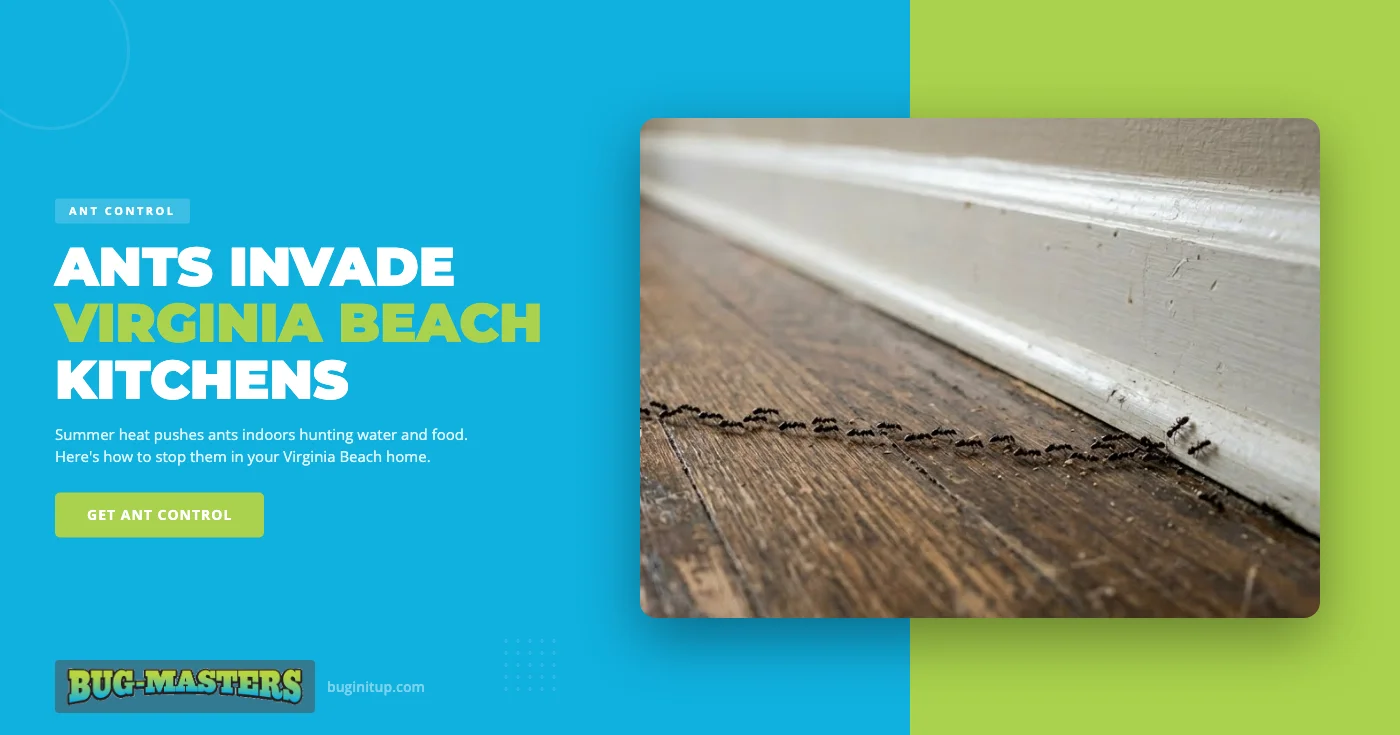
Every Virginia Beach homeowner has had that moment — you walk into the kitchen on a sticky June morning and there it is: a thin black line of ants marching from the baseboard to a crumb on the counter. By Father's Day weekend, our phones at Bug Masters start ringing about exactly this scene. Summer heat in Hampton Roads pushes entire colonies out of the yard and into the cooler, wetter, food-rich environment behind your kitchen wall. In this guide, we'll cover why kitchen ant pressure climbs so fast in Virginia Beach, which species are most likely at your sink, and what real ant control in Virginia Beach, VA looks like once a colony has decided your house is home.
Coastal Virginia is one of the most ant-friendly stretches on the East Coast, and Virginia Beach sits right in the middle of it. Sandy soils, heavy summer rain, year-round humidity, and milder winters add up to colonies that survive winter largely intact and explode in size the moment temperatures climb. By mid-June, daytime highs are in the upper 80s, overnight lows stay above 70, and soil temperatures have been above 70 for weeks.
When outdoor conditions push past that comfort window, three things happen fast:
The result is the pattern Virginia Beach homeowners know by heart: a manageable yard in May becomes a kitchen invasion by July. Once one scout finds a reliable food source inside, the rest of the colony learns about it within hours.
Identifying the species is the first step to solving the problem. The four we see most often in Virginia Beach kitchens are:
Each species responds to different treatments. Carpenter ants demand a moisture fix as much as a chemical one; odorous house ants and little black ants respond best to slow-acting baits workers carry back to the queen. The wrong product on the wrong species is one of the most common reasons DIY ant control fails in Virginia Beach kitchens.
Ants do not get lost. When a single ant shows up on your counter, it's a scout laying a chemical pheromone trail back to the nest. As soon as that scout finds food, it lays down a stronger return trail, and within an hour you can have a steady column of workers using the same invisible highway.
The entry points scouts find most often in Virginia Beach homes are:
Odorous house ants can squeeze through openings the width of a credit card edge. That's why caulking only the spot where you see the trail rarely solves the problem — the colony already knows ten other ways in. Effective ant control in Virginia Beach, VA pairs entry-point sealing with treatments that reach the colony itself.
Every kitchen has habits that quietly broadcast "open for business" to a scouting ant. Most are easy to fix:
None of these habits cause ants on their own — the colony has to already be nearby. But in Hampton Roads, where outdoor ant pressure is constant from May through October, a single overlooked habit is often the difference between a quiet yard and a kitchen invasion.
The most effective ant prevention in Virginia Beach is unglamorous and inexpensive. Five steps cover most of what we'd recommend after walking any kitchen:
These steps will not eliminate an established colony, but they lower the pressure to a level where targeted professional treatment can finish the job in a single visit.
This is the part homeowners are most surprised to hear: the can of contact spray under your sink almost certainly made the problem worse.
Most over-the-counter ant sprays use fast-acting pyrethroids designed to kill on contact. They work as advertised on the workers you can see — but those workers are only 5 to 10 percent of the colony. The other 90+ percent, including the queen and brood, never touch the spray. Worse, pyrethroid sprays are repellent: ants detect and avoid them. When the colony senses a chemical threat at an entry point, it often responds by budding — a queen takes a portion of workers and brood and relocates to a new spot in a wall void, baseboard, or attic. One colony becomes two or three, all hidden in new locations.
The EPA's IPM principles recommend the opposite approach: accurate identification, source reduction, and the most targeted control available before reaching for broadcast pesticides. For ants, that means slow-acting baits and non-repellent gels scouts carry back unaware. The active ingredient moves through the nest, reaches the queen, and collapses the colony. If you've already sprayed and the problem got worse a week later, that's budding in real time.
Our team has treated ant problems in Virginia Beach kitchens for years, and our process is built around how local colonies actually behave. A first visit looks like this:
Our technicians are licensed by the Virginia Department of Agriculture and Consumer Services, and every product is selected with your family, pets, and the tidewater ecosystem in mind.
How fast does professional ant treatment work in Virginia Beach?
Visible activity usually drops within 48 to 72 hours of the first interior treatment, and most kitchens are clear within 7 to 14 days. The delay is intentional — non-repellent products reach the queen through the colony's social network, not by killing the workers you can see.
Are the products gentle around kids and pets?
We use professional products at residential-approved rates. Interior gels go in cracks and crevices children and pets cannot access, and we ask families to stay off treated exterior areas until the application has dried, usually about 30 minutes.
Why do ants keep coming back to the same spot in my kitchen?
A persistent trail usually means a moisture source, an unidentified food source, or a hidden nest in the wall void. Repeated activity after a treatment is a signal to look harder at moisture and consider that part of the colony may have moved inside the structure.
Do I really need recurring service, or is a one-time treatment enough?
A one-time treatment solves the immediate kitchen problem in most cases. Whether you need recurring service depends on outdoor ant pressure. In Virginia Beach, where sandy soils and humidity sustain huge outdoor populations from May through October, most homes benefit from a quarterly or bi-monthly program.
How do I tell odorous house ants from carpenter ants?
Size and color. Odorous house ants are tiny (about 1/8 inch), brown to black, and smell like rotten coconut when crushed. Carpenter ants are much larger (up to 1/2 inch), solid black with a pinched waist, and often leave sawdust-like debris near a nest entry — almost always a sign of hidden moisture.
By late June, Virginia Beach kitchens are in the thick of summer ant season, and the combination of heat, humidity, and peak colony populations only climbs through July and August. The right mix of source reduction, entry-point sealing, and targeted professional treatment can shut down a kitchen invasion in a single visit. Our team has protected Virginia Beach homes for years across the wider Hampton Roads region. If you're ready to take your kitchen back, learn more about our Ant Pest Control service or get in touch today.