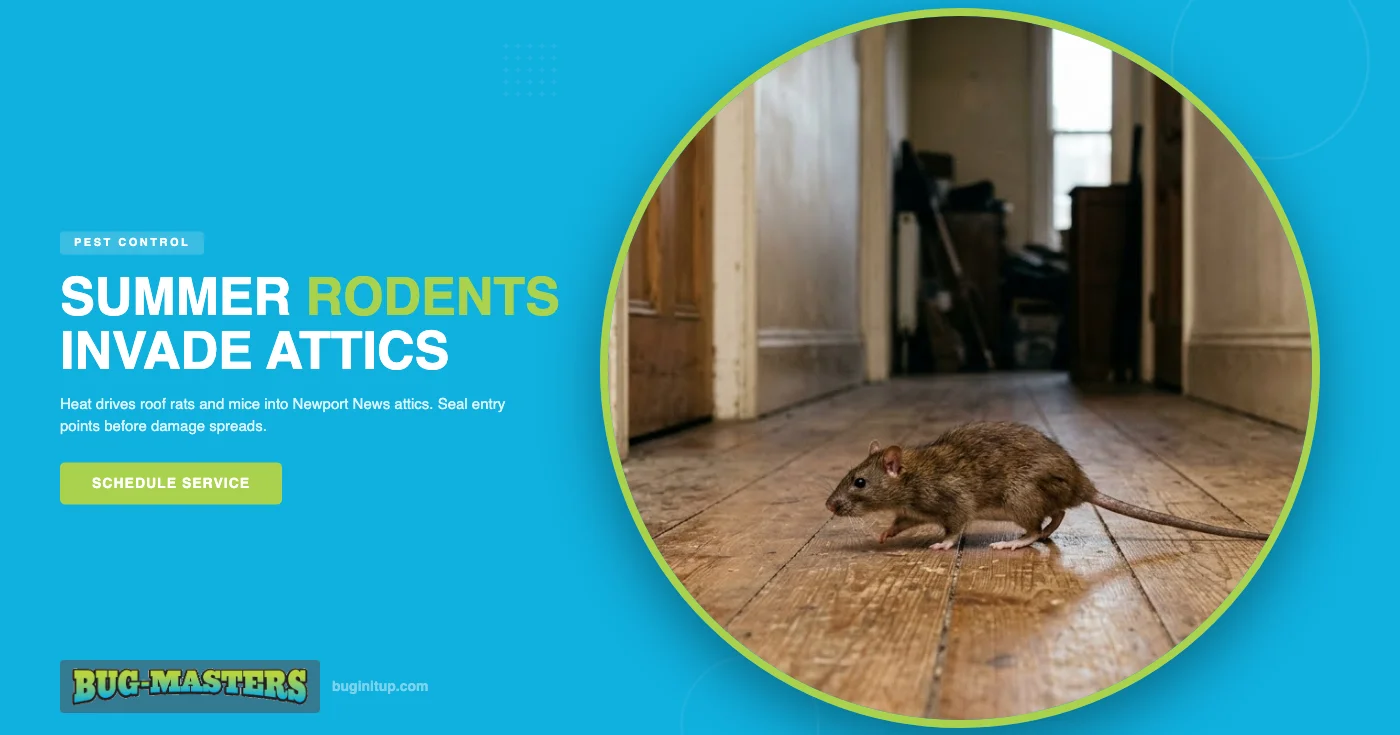
Newport News homeowners dealing with strange scratching sounds from above, disturbed insulation, or droppings in the attic might be surprised to learn that summer is one of the peak seasons for rodent intrusion—not just fall. The common perception is that mice and rats move indoors when temperatures drop, but in the Hampton Roads region, summer heat creates its own set of conditions that push rodents out of their outdoor habitat and directly into attic spaces.
Understanding why this happens, how to identify the signs early, and what to do when rodents have already moved in are the critical steps for Newport News homeowners who want to protect one of their home's most important structural spaces.
Why Newport News, VA Attics Are Prime Rodent Territory in Summer
Attics in Hampton Roads share a set of characteristics that make them ideal for rodents year-round, but these characteristics become especially attractive during summer for specific reasons.
First, Newport News attics are typically accessible. The Hampton Roads region has a significant stock of older housing—homes built from the 1940s through the 1980s that were constructed with less rigorous pest exclusion than modern building codes require. Rooflines on these homes commonly have openings around soffit vents, gaps in fascia boards, and deteriorating gable vents that provide easy overhead access for rats and squirrels, and sometimes mice.
Second, attics offer something the summer outdoor environment increasingly can't: stable conditions. As temperatures outside climb into the mid-90s and higher in July and August, attic temperatures (while hot themselves during peak afternoon hours) become more stable relative to exposed outdoor environments. More critically, attics provide what the forest edge and scrubland habitat around Newport News can't during summer heat: reliable concealment, nesting material, and proximity to food sources in the living space below.
Third, the Hampton Roads region's combination of heat and summer humidity creates outdoor conditions that stress rodent populations. Standing water and high humidity support increased insect populations—which attract rodents—while also causing outdoor nesting sites in leaf litter and brush to become uncomfortable and exposed. Rodents that might remain in outdoor habitat during milder seasons find their outdoor options progressively less hospitable as summer intensifies.
Understanding Summer Rodent Migration Patterns in Hampton Roads
The two rodent species most commonly found in Newport News attics are the roof rat (Rattus rattus) and the Norway rat (Rattus norvegicus). While they sometimes overlap in urban and suburban environments, they have distinct habits that affect how they enter and use attic spaces.
Roof rats are the more likely attic species. True to their name, they're excellent climbers and prefer elevated nesting sites. In Hampton Roads, roof rats are common in neighborhoods with mature tree canopies, since overhanging branches provide direct access to rooflines. A single tree branch hanging over or near the roofline is sufficient for a roof rat to access your attic. Once inside, roof rats nest in insulation, build pathways through your attic space, and forage down into the living areas of your home in search of food.
Norway rats are more typically associated with ground-level and basement spaces, but they're opportunistic and will follow structural entry points wherever they lead—including up through wall voids to attic spaces. In Newport News neighborhoods near the waterfront, marinas, and older commercial districts, Norway rat pressure on residential properties can be significant during summer months.
House mice (Mus musculus), while smaller than both rat species, are also attic inhabitants. They're prolific breeders—capable of producing a new litter every three weeks under favorable conditions—and their small size allows them to enter through openings barely larger than a pencil eraser.
How Rodents Enter Newport News Homes and Attics
Every attic intrusion begins with an entry point, and every entry point can be sealed. The challenge is that rodents are highly motivated and physically capable of exploiting openings that most homeowners would never identify as potential access points.
The most common entry routes for attic-seeking rodents in Newport News include:
- Gable vents: Older homes with louvered or mesh gable vents frequently have screens that have degraded, rusted away, or been torn by previous wildlife activity. These vents are positioned exactly where roof rats and squirrels want to be—elevated, sheltered from rain, and opening directly into attic space.
- Ridge vents: Modern ridge vent systems, when properly installed, are effective at keeping wildlife out. Older ridge cap construction, particularly on homes with wooden shakes or older composition roofing, often has gaps at the peak that are large enough for mice and occasionally rats to exploit.
- Fascia board gaps: Where fascia boards have warped, rotted, or pulled away from the soffit, gaps form at the roofline junction. These gaps are not obvious from ground level but are often visible during a professional inspection with a ladder.
- Overhanging tree limbs: This is perhaps the most common overlooked entry vector for roof rats specifically. A branch that appears to hang safely above the roofline is actually a bridge for a rat that can jump more than four feet horizontally and two feet vertically. Trimming all tree branches to a minimum of six feet from the roofline is the preventive standard.
- Utility penetrations at the roofline: HVAC units, plumbing vent stacks, and other services that exit through the roof create gaps where they penetrate the roofing material. Over time, flashing separates, caulk degrades, and these penetrations become entry points.
Signs of Rodent Activity in Your Newport News Attic
Most homeowners discover an attic rodent problem through indirect signs before they ever see an animal. The attic environment makes direct observation difficult, but the evidence rodents leave behind is distinctive enough to allow confident identification.
Scratching and scurrying sounds: The most common first sign is sound—typically at night, when rodents are most active. Scratching, running, or gnawing sounds from the ceiling or attic access area are classic indicators. Roof rat activity often sounds like movement along beams; mouse activity is lighter and may sound like rustling in insulation.
Disturbed insulation: During an attic inspection, flattened insulation runways, tunneled pathways through blown-in insulation, and areas where insulation has been excavated for nesting material are all signs of active rodent use. Fresh insulation damage (fibers still pliable, no dusty compaction) indicates recent or current activity.
Droppings along beams and walls: Rodent droppings accumulate along the pathways animals use consistently. In an attic, these pathways tend to follow structural members—roof joists, cross-bracing, and the perimeter of the attic floor. Rat droppings are approximately half an inch long and tapered; mouse droppings are much smaller, about the size of a grain of rice.
Nesting material: Active rodent nests in attics are constructed from insulation fibers, fabric, plant material, and whatever else the animal can find. A compact pile of shredded material, often in a corner or at the junction of structural members, indicates current or recent nesting.
Chewed materials: Wood beams, electrical wiring, HVAC duct connections, and plastic plumbing pipes are all vulnerable to rodent gnawing. Chewed wiring in an attic is particularly serious—it's a leading cause of attic fires and is frequently invisible until a problem develops.
Odor: A strong ammonia smell in the attic is typically associated with accumulated rodent urine, which indicates a significant or long-term infestation. This level of contamination usually requires professional remediation beyond simply removing the animals.
Damage Rodents Cause in Attics and Crawl Spaces
The damage a rodent infestation can cause to a Newport News attic ranges from nuisance-level to structurally and financially significant, depending on how long the infestation has been active and the species involved.
Insulation damage: Rodent activity compresses, tunnels through, and contaminates attic insulation. An attic with active rodent presence loses thermal efficiency as the insulation is degraded—which means higher energy costs. Insulation contaminated with droppings and urine is a health concern and typically needs to be removed and replaced rather than simply treated.
Electrical damage: Rodents gnaw electrical wiring to wear down their continuously-growing incisors. A single chewed wire in an attic can create a circuit fault that's difficult to trace and potentially dangerous. The National Fire Protection Association identifies rodent gnawing as a significant cause of attic fires in residential construction.
HVAC duct damage: Flexible duct connections in attic-based HVAC systems are frequently targeted by rodents for nesting material. Damaged ductwork allows conditioned air to escape into the attic rather than entering the living space—reducing system efficiency and potentially creating entry points for rodent movement into the home's air distribution system.
Structural wood damage: While rodents don't eat wood the way termites do, sustained gnawing at structural members for entry points can weaken the wood. This is more commonly an issue where entry is occurring repeatedly at the same location.
Preventing Rodent Entry in Newport News Homes
Exclusion—physically blocking all entry points—is the only permanent solution to attic rodent problems. Trapping and other active control methods are necessary to address current infestations, but without exclusion, new rodents will eventually find the same entry points that the current occupants used.
A thorough exclusion process for a Newport News home typically includes:
- Roofline inspection and sealing: Every gap, crack, and damaged area at the roofline is identified and sealed using materials rodents cannot chew through—hardware cloth, sheet metal flashing, and copper mesh are standard. Expandable foam alone is not sufficient, as rodents can chew through it.
- Vent screening replacement: Gable vents and ridge vent openings are covered with quarter-inch hardware cloth, properly secured to prevent being pushed or pulled out. Existing vented soffits are inspected for gaps and repaired.
- Tree limb management: A documented inspection of all overhanging limbs with recommendations for trimming is part of a complete exclusion assessment. Removing the bridge is often as important as sealing the door.
- Utility penetration sealing: All roof penetrations are checked and resealed where necessary, including flashing around plumbing stacks and HVAC penetrations.
When Should I Call a Newport News Rodent Control Expert?
If you're hearing sounds from your attic, finding droppings, or noticing unexplained damage to stored items—particularly during summer months when rodent pressure in Hampton Roads peaks—professional intervention is the right next step.
A professional rodent inspection does more than confirm an infestation. It identifies every viable entry point around your home, assesses the scale of the current infestation through trap monitoring, determines whether structural damage requires remediation, and produces an exclusion plan tailored to your specific property. Attic rodent problems that are addressed thoroughly at the start—with both active control and complete exclusion—don't recur the following summer. Problems that are handled with trapping alone but no exclusion typically cycle back, because new rodents find the same access points.
For Newport News homeowners experiencing rodent activity, Newport News rodent control from a licensed professional is the most reliable path to a permanent resolution. Our team serves Newport News and the surrounding Hampton Roads communities, including Chesapeake, Hampton, and the Peninsula. We understand the specific species pressure and structural vulnerabilities common to housing in this region.
Don't wait until the infestation grows or the wiring damage becomes visible. If you're seeing the signs, the sooner you act, the less extensive—and less costly—the solution. Contact Bug Masters today to schedule a thorough attic inspection and protect your home through the rest of the summer and beyond.