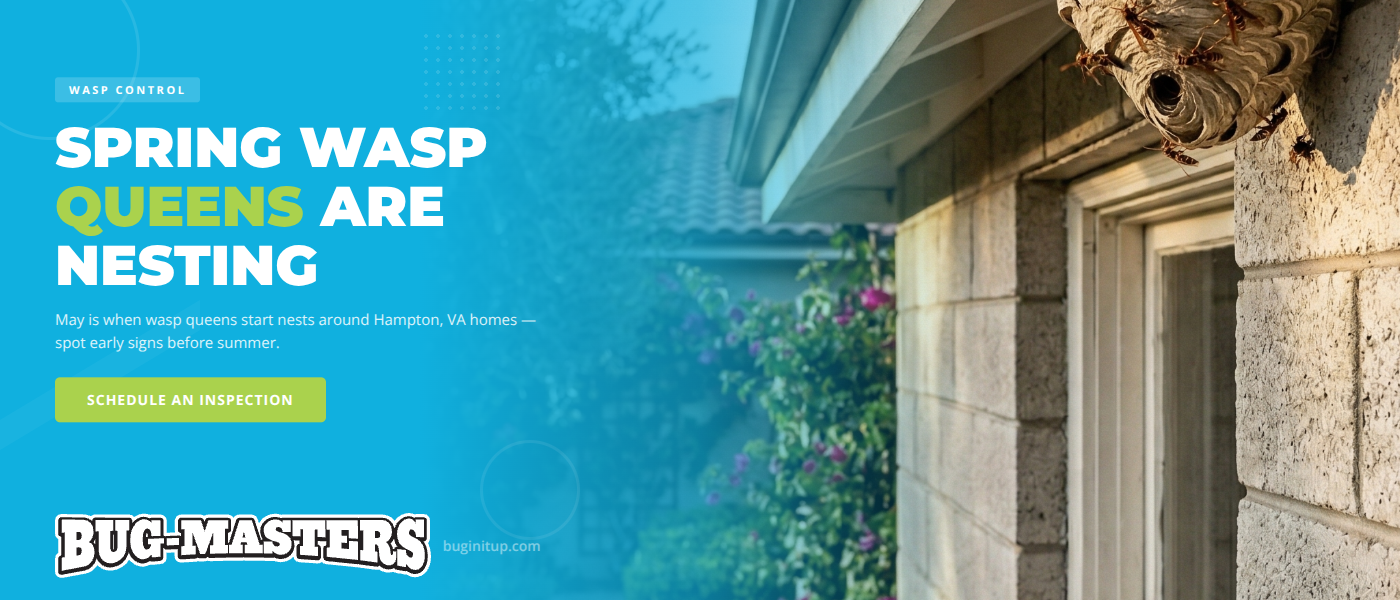
By the first week of May, we start hearing from Hampton, VA homeowners who noticed something new — a single dark wasp circling under a porch ceiling, scratching at a weathered fence rail, or hovering at the corner of a shed roof. That solo wasp is almost always a fertilized queen, and she isn't visiting. She's deciding whether to start a colony at the address.
Effective wasp nest prevention in Hampton, VA hinges on what happens during these few weeks. At Bug-Masters, we've spent decades treating stinging insects across Hampton and the rest of Hampton Roads. This guide is for the homeowner who wants to stop a nest before it's built — not call us in August when it's the size of a softball.
Paper-wasp queens are the first social wasps to emerge each spring, usually when daytime temperatures hold above 50°F for a few days. In coastal Virginia, early scouts appear in late March and the peak nest-founding window runs through May. Yellowjacket and hornet queens follow a few weeks later — solo queens, no workers yet, building starter nests no bigger than a quarter.
That's the window where wasp nest prevention in Hampton, VA actually works. According to Virginia Cooperative Extension, only fertilized queens overwinter — the rest of the colony dies off in fall. Every nest you see in July traces back to one queen that found a spot in May. Wait six weeks and you're dealing with hundreds of defensive workers instead of one.
A queen looking for a nest site is checking three boxes: shelter from rain, southeast or south-facing warmth in the morning, and a structure she can grip and chew into pulp. Hampton homes offer all three in dozens of overlooked spots. The most common nest locations we find on local properties include:
Yellowjacket queens prefer ground cavities, rodent burrows, and wall voids — they get inside through a single quarter-inch gap and may not be visible until midsummer when foragers stream in and out. Bald-faced hornets target tree branches eight to twenty feet up and the corners of two-story siding.
Hampton Roads sees five regular stinging insects during spring and summer. Telling them apart matters because the response is different for each. Here's the quick local guide:
The University of Maryland Extension notes that all five species prey on garden caterpillars and other pests, which is why we treat the species at the structure rather than blanket-treating yards.
Most Hampton homeowners don't realize a nest is building until it's already a problem. The signs show up earlier — they're just easy to miss. Here's what to watch for during a five-minute walk-around:
Spotting any of these in May or June puts you in the prevention window. Spotting them in July or August usually means the colony is already in the dozens-to-hundreds and needs professional treatment.
The point of spring wasp work is making your structure boring to a queen — and uninviting to the next one if she does land. These are the five steps we walk Hampton customers through every year:
Done before Memorial Day, the sequence prevents most of the nests we'd otherwise be removing in July and August.
Hardware-store wasp sprays are designed to knock down a small visible nest from twenty feet away in a single shot. They work for what they're built for — a paper-wasp starter the size of a half-dollar, treated at dawn or dusk when the queen is the only wasp on the comb. Most calls we get aren't for starter nests, though. They're for established colonies a homeowner already tried to spray. Three things go wrong:
For starter nests in May, a careful homeowner with a long pole and a cool morning can handle it. For anything else from June onward — call a pro before you make it worse.
Some calls can wait a week. Others should not wait an afternoon. Here's how we triage Hampton, VA wasp calls:
At Bug-Masters, our wasp nest prevention in Hampton, VA service is built around the spring queening window first, with rapid-response removal for established nests when prevention timing has passed. We document active nests, recommend the lowest-impact effective treatment, and include the perimeter in any related general pest control visit. We serve Hampton, Newport News, Norfolk, Virginia Beach, Chesapeake, Portsmouth, and Suffolk. Reach out through our contact page for a free property assessment before peak nest-building wraps up.
Paper-wasp queens in Hampton typically begin scouting nest sites in late March, with the heaviest nest-founding activity running from mid-April through May. Yellowjacket and hornet queens follow a few weeks later. Hampton's mild Tidewater spring usually puts our first queens out a couple of weeks ahead of inland Virginia.
Sheltered overhead surfaces, southeast morning sun, and access to raw wood pulp. Front porches and covered patios in Hampton check all three, especially when grill covers, patio umbrellas, and folded outdoor furniture have sat in place over winter. Sealing cavities, stowing soft items indoors, and walking the porch ceiling weekly through May breaks the pattern.
Inspect every eave and soffit return in late April and again in mid-May, knock down any starter nest the size of a golf ball or smaller on a cool morning before the queen is active, and have a residual perimeter treatment applied to eaves, soffits, and porch ceilings in early spring. The perimeter work is what discourages queens from re-landing after you remove a starter.
Yes — in Hampton it's a smart housekeeping step. Paper-wasp colonies do not reuse old nests, but the existing structure can attract new queens to the same spot in spring. Removing old nests in February or early March, before queens emerge, reduces re-nesting near the old site.
For a true starter nest under a quarter-sized in May, with a long pole and a cool morning, a careful homeowner can handle it. For anything established — a fist-sized paper-wasp comb, any yellowjacket ground or wall-void colony, or any hornet nest — DIY spray cans usually scatter the colony, push them deeper into the structure, and trigger a defensive response. Call a pro and let us treat the colony where it lives.
Yes. Bug-Masters provides wasp nest prevention in Hampton, VA and across Hampton Roads, including Newport News, Norfolk, Virginia Beach, Chesapeake, Portsmouth, and Suffolk. Reach out through our contact page to schedule a free property assessment before peak nest-building wraps up.
Yes. Our technicians follow all label instructions and walk you through the products and methods used during your assessment, plus any steps to take before or after each visit so your family and pets stay comfortable.