By the first warm week of June, the calls start. A homeowner mowing along a fence line in Great Bridge gets stung four times before they understand what's happening. A landscaper edging a Western Branch flower bed kicks up what looked like a squirrel hole and ends up running across the lawn with a cloud trailing behind. Early summer in Chesapeake, VA is when yellowjacket colonies stop being invisible.
Effective yellowjacket control in Chesapeake, VA depends on understanding what's already happening in those hidden nests before the colony grows large enough to attack. At Bug-Masters, we've spent decades treating stinging insects across Chesapeake and Hampton Roads. This guide breaks down why yellowjackets get aggressive so early here, where they hide, and what works when you find a nest on the property.
Every yellowjacket nest in Chesapeake traces back to a single overwintered queen. According to Virginia Cooperative Extension, a fertilized queen emerges in spring, builds a starter nest of 30 to 50 cells alone, and feeds the first batch of larvae herself for nearly three weeks. The first workers emerge in June, and from that point the colony doubles, then doubles again.
Chesapeake's climate accelerates every step. Humid Hampton Roads summers shorten brood development and push the queen to lay more eggs per day. Mild Tidewater winters increase the share of queens that survive in the first place. A colony nobody noticed in April can hold a few hundred workers by the last week of June — and 3,000 to 5,000 by August. By the time most homeowners see the first sting, the colony is already past the small-nest stage and into defensive territory.
Yellowjackets are the most dangerous stinging insect we treat in Chesapeake because they behave differently from every other local wasp. The response is different for each:
Paper wasps and mud daubers tolerate humans because their colonies are tiny or nonexistent. Yellowjackets do not. A worker yellowjacket has a smooth, lance-like stinger that withdraws cleanly from skin — one wasp can sting you four or five times in a single encounter, and her alarm pheromone calls in everyone else.
Yellowjackets nest where they can defend a single entrance and hide the rest of the colony. The University of Maryland Extension describes the nest as a multi-layered gray paper envelope around stacked combs — and the visible entrance can sit 20 or 30 feet away from where the colony actually lives inside a wall. The hidden locations we find most often on Chesapeake properties:
The telltale sign for all of these is the same: a sustained, one-way stream of workers flying in and out of one small hole during daylight. Random foraging wasps don't repeat the same flight path. Nest workers do. Watch a spot for two minutes — if traffic never stops, you've found the entrance, even if the colony is deep behind it.
According to the CDC, hornet, wasp, and bee stings kill an average of 60 to 90 Americans every year — almost always from anaphylaxis. About 3% of adults and up to 0.8% of children have a potentially life-threatening allergic reaction to insect venom. That matters when a single yellowjacket encounter can deliver dozens of stings in seconds. Four things make yellowjacket stings uniquely dangerous:
If anyone in your household has had a previous systemic reaction to an insect sting, the chance of another on the next sting is as high as 70%. Talk to an allergist about an EpiPen before yellowjacket season hits full stride.
Hardware-store wasp aerosols are built for one job: knocking down a small visible nest from twenty feet away in a single burst. For a paper-wasp starter the size of a half-dollar at dawn, that works. For a yellowjacket colony, the same can usually makes things worse. Three things go wrong:
The other failure mode is sealing the entrance. A homeowner who finally locates a wall-void nest and caulks it shut traps thousands of yellowjackets inside the structure — and they will chew through drywall into the living space looking for a new exit. Never seal the hole before the colony is dead.
Our approach is built around insecticidal dusts, not aerosols. Dust particles adhere to workers and get tracked deep into the colony — the queen and brood receive a lethal dose without us ever reaching them directly. Our typical Chesapeake protocol:
For households with stinging allergies, children, pets, or any nest within ten feet of a doorway or play area, our emergency pest control service can respond the same day.
Once an active colony is cleared, the next conversation is keeping next year's queens from picking the same property. Most Chesapeake nests start because the yard is already attractive. The prevention steps we walk homeowners through:
At Bug-Masters, our yellowjacket control in Chesapeake, VA service covers emergency colony removal through spring perimeter prevention. We serve Chesapeake, Virginia Beach, Norfolk, Portsmouth, Suffolk, Hampton, and Newport News. Reach out through our contact page for a property assessment before the colony grows into a real problem.
Colonies reach defensive size by late June or early July, with peak aggression running from mid-July through September. The most dangerous stretch is late August into September, when colonies are at maximum population and food-scarce adult workers scavenge human sugar sources around outdoor activity.
Watch for sustained one-way traffic — workers flying in and out of the same small hole on the same flight path for minutes at a time. On a warm afternoon, walk the perimeter and scan for steady traffic at soffit seams, siding gaps, ground holes, retaining-wall voids, and the base of large trees.
For a small starter nest under a porch eave in May, with a long pole on a cool morning, a careful homeowner can sometimes manage. For any established summer nest — any ground colony, any wall-void colony, or any nest larger than a baseball — DIY aerosol cans almost always fail. Mid-summer yellowjacket removal in Chesapeake should be handled by a professional with the right dust formulations.
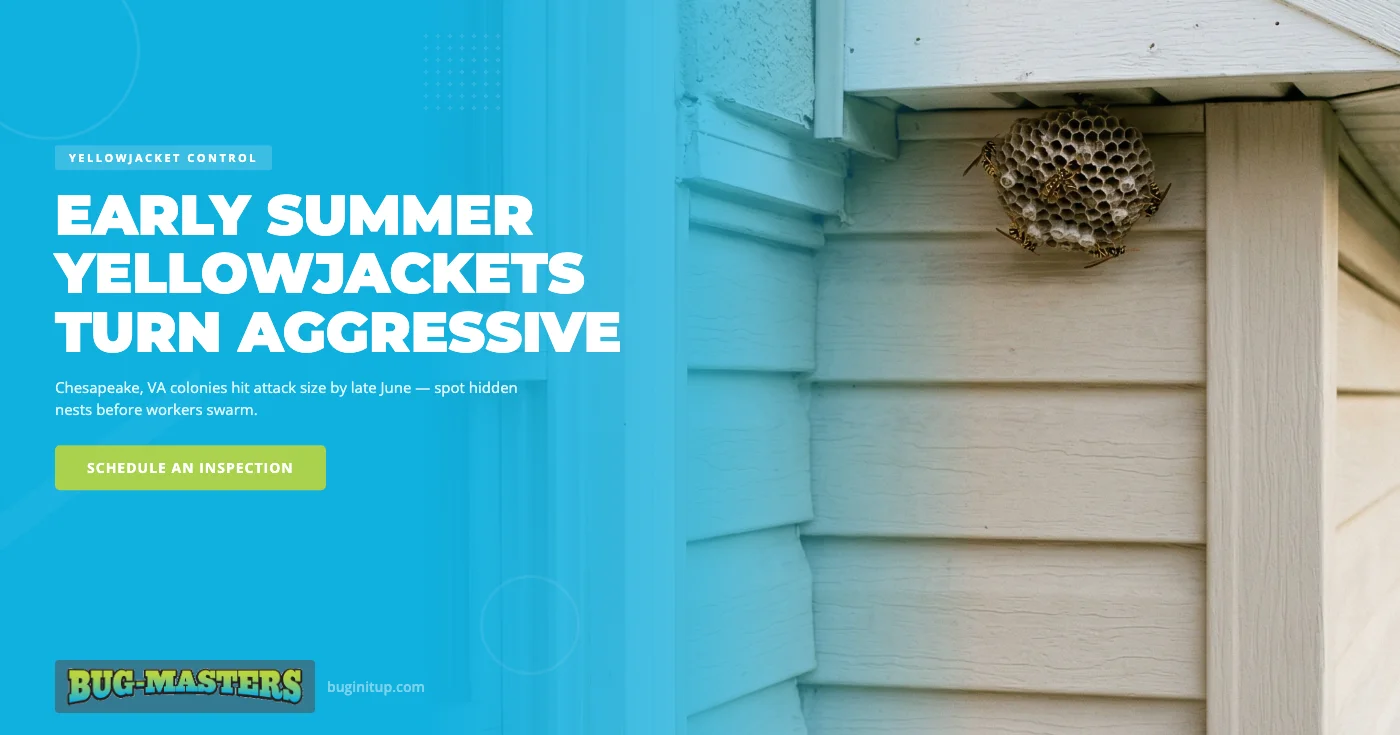
Yellowjacket nests are fully enclosed gray paper envelopes around stacked combs with a single entrance. Paper-wasp nests are open umbrella-shaped single combs with no envelope, usually under an eave. Yellowjacket colonies hold thousands at peak; paper wasp colonies a few dozen.
Move away immediately — alarm pheromones recruit more attackers. Wash with soap and water, apply a cold compress, take an oral antihistamine if appropriate. Call 911 for any breathing difficulty, facial swelling, hives spreading beyond the sting site, dizziness, or 25+ stings. Anyone with a known venom allergy should use their EpiPen first, then call 911.
Yes. Bug-Masters provides yellowjacket control in Chesapeake, VA and across Hampton Roads, including Virginia Beach, Norfolk, Portsmouth, Suffolk, Hampton, and Newport News. For active colonies near doorways, decks, or high-traffic areas, our emergency pest control service responds quickly. Reach out through our contact page to schedule an assessment.
Yes. Our technicians follow all label instructions and walk you through the products and methods used during your assessment, plus any steps to take before or after each visit so your family and pets stay comfortable.