
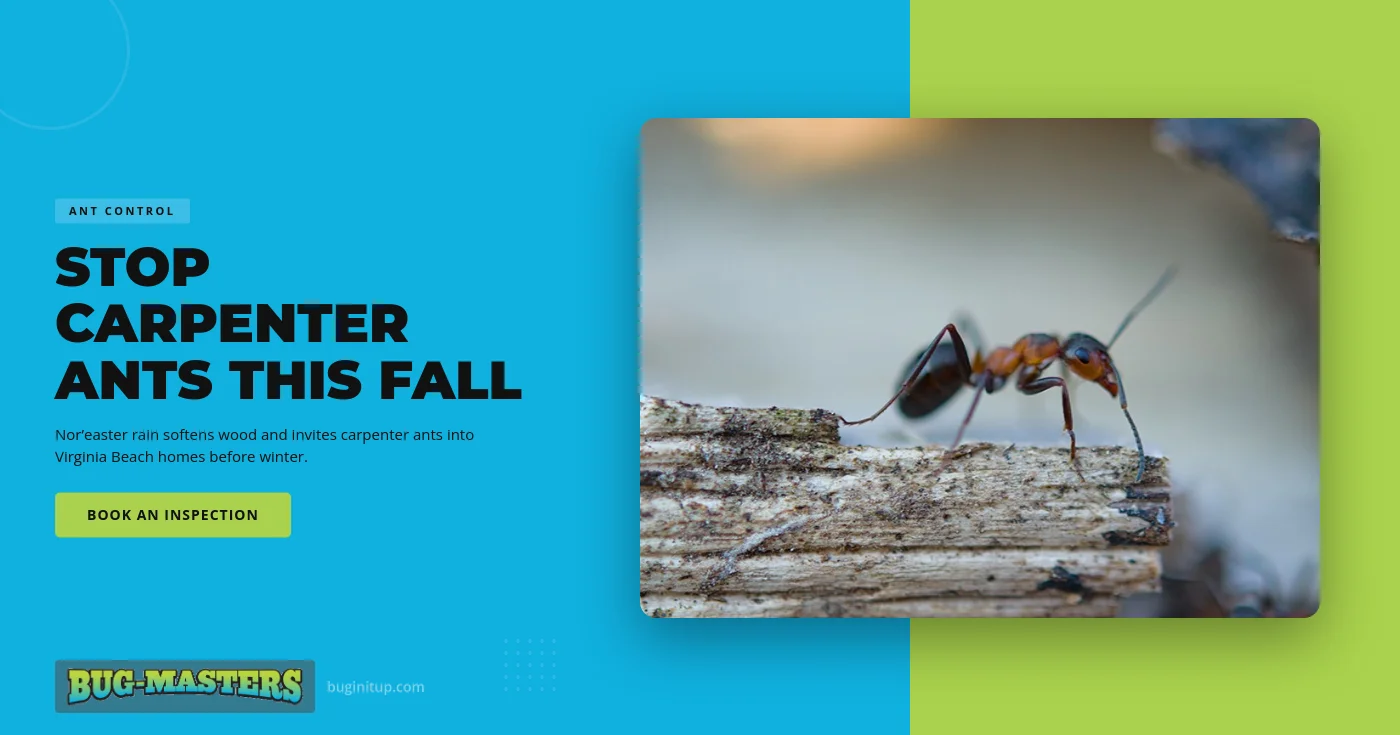
You notice a few large black ants crossing the kitchen counter on a cool October evening, plus a small pile of what looks like sawdust under the window sill. If that sounds familiar, you’re not alone. Fall is when many homeowners start looking for carpenter ant control Virginia Beach residents can count on. After weeks of nor’easters and the tail end of hurricane season, the wood in and around our homes is often softer and damper than at any other time of year, and carpenter ants notice.
Here at Bug Masters, we’ve been helping homeowners across Virginia Beach and the rest of Hampton Roads deal with ants since 2011. Carpenter ants are very different from the little sugar ants that show up in summer. They don’t eat wood, but they tunnel through it to build nests. Over time that tunneling adds up to real carpenter ant damage, especially in wood that moisture has already weakened.
In this guide, we’ll explain why carpenter ants in fall are so common along the coast, the warning signs, how to tell them from termites, how we treat them and how to keep them out through winter.
Carpenter ants are active from spring through fall, but October brings a shift in behavior that puts them in front of homeowners. The most common species in Virginia is the black carpenter ant (Camponotus pennsylvanicus), a large ant that lives in colonies made up of a main parent nest and several satellite nests.
The parent nest is usually outdoors in a stump, a hollow tree, landscape timbers or an old fence post. Satellite nests branch off from there, and a house with soft, damp wood is an ideal spot for one. As nights cool, foraging workers look for shelter and steady warmth. The wall voids of a heated home offer both.
Fall weather adds a second push. Weeks of rain flood outdoor nesting sites. The same rain saturates the wood around your home that carpenter ants prefer to excavate, including sill plates, trim and deck framing. That combination is why so many calls about carpenter ants in fall come in after a stormy stretch.
Moisture is the single biggest factor behind a carpenter ant problem. University extension entomologists note that these ants usually start nests in wood that is already damp or decaying. Once the colony is established, it can expand into sound wood. On the coast, fall delivers that moisture in bulk.
Hurricane season officially runs from June 1 through November 30, and nor’easters become common along the Hampton Roads coast from October onward. These storms bring wind-driven rain that gets pushed sideways into window seams, under siding and around door thresholds, where ordinary rain rarely reaches.
The National Weather Service office in Wakefield tracks these systems for our region, and a single slow-moving storm can mean days of soaking rain. Wood that stays wet that long softens, and that’s exactly what carpenter ants look for.
Our high humidity and high water table keep many crawl spaces damp year-round. Floor joists and sill plates that never fully dry out are prime territory for moisture damaged wood ants. The problem often goes unnoticed because few people check under the house.
That’s why we pair ant work with moisture control options such as vapor barriers, crawl space encapsulation and dehumidification. Taking away the damp wood takes away the invitation.
Carpenter ants work quietly, so the clues are easy to miss. After a heavy storm, these are the signs of carpenter ants we tell homeowners to watch for:
Winged carpenter ants and termite swarmers get mixed up all the time, and the difference matters. The two pests call for different treatments, and termites can cause far more structural damage in a shorter time. Here’s how to tell them apart, based on guidance from Penn State Extension and other university sources:
If you’re not sure what you’re looking at, save a sample or take a photo. Our WDI-certified team can identify it. If it turns out to be termites, we’ll walk you through our termite treatment options.
Because colonies split into satellite nests, carpenter ants can be living in several spots around a home at once. These are the places we check first.
Wind-driven rain finds its way into window seams and door thresholds. Caulk that cracked over the summer lets water soak into the frame. Soft sills and jambs are among the most common indoor nesting sites we find in fall.
Deck ledger boards, porch posts, fascia and soffits stay wet after storms, especially where gutters overflow. Branches touching the roof give ants an easy bridge from a parent nest in a tree straight into the attic.
Damp sill plates and joists in the crawl space are classic satellite nest locations. From there, ants move into wall voids, where insulation and warmth make a comfortable winter home. Pay special attention to wall voids near bathrooms, kitchens, chimneys and skylights, or anywhere else a slow leak might be hiding.
Getting rid of carpenter ants in wall voids starts with finding the right void. Spraying the ants you see on the surface rarely reaches the colony inside, which is why the nest location matters so much.
Here at Bug Masters, we treat carpenter ants as two problems: the colony and the conditions that invited it. Killing the ants you can see without dealing with either one is why so many DIY efforts end with the ants coming right back.
Every visit starts with a thorough inspection inside and out. We trace foraging trails, look for frass, check moisture-prone wood and walk the yard for stumps, trees or timbers that could hold the parent nest. Our technicians wear body cameras on every job, so you have peace of mind about exactly what was done in your home.
Depending on what we find, treatment may include:
As an ant exterminator Virginia Beach VA families call, we tailor each plan to the home instead of relying on a one-size-fits-all spray.
Finally, we point out the leaks, rot and damp areas that drew the ants in, and we recommend moisture control where it makes sense. We offer same-day service and are available 24 hours a day, seven days a week, so we can usually reach you quickly when ants show up after a storm.
Fall is the ideal time to make your home less appealing, before colonies settle in for the cold months. Work through this checklist after the next big storm passes:
None of these steps eliminates an existing colony, so if you’ve already seen signs inside, pair this list with a professional inspection.
Cooling temperatures and heavy fall rain push foragers toward warm, sheltered spots, and storm-soaked wood gives them easy places to nest. Ants you see indoors in October may be foragers from an outdoor parent nest, or they may come from a satellite nest already inside.
Outdoor colonies slow down considerably as temperatures drop. Nests inside heated wall voids, however, can stay active through the winter. That’s why ants seen indoors in January deserve attention.
Sprays may kill the ants you can see, but they rarely reach the parent or satellite nests. Some repellent sprays can even scatter a colony into new locations. Lasting results usually require finding and treating the nests themselves.
Nor’easter rain and lingering hurricane-season moisture make fall prime time for carpenter ants to move into softened wood. Catching them now, before satellite nests settle into your walls for winter, can save you a lot of repair work later. If you’re finding frass, hearing rustling or seeing large ants at night, it’s time for professional carpenter ant control Virginia Beach homeowners trust.
Bug Masters has been protecting homes across Hampton Roads since 2011. Along with our home city, we serve Norfolk, Chesapeake, Portsmouth, Suffolk, Hampton and Newport News. We’re NPMA and VPMA members and WDI certified. We back every visit with fast response times and a quality-over-quantity approach, from ant pest control Virginia Beach families rely on to general pest control all year long. Contact Bug Masters today to schedule your carpenter ant inspection.
When fall storms roll through, we get a lot of calls about big black ants showing up in kitchens, bathrooms and crawl spaces. Nor’easter rain and leftover hurricane-season moisture soften window frames, deck boards and sill plates. That damp wood is exactly where carpenter ants like to build satellite nests. We’ve been helping homeowners across Hampton Roads with these problems since 2011, and we know that lasting results come from treating both the colony and the moisture behind it.
Here’s how we handle carpenter ants:
Every one of our technicians wears a body camera on the job, so you have peace of mind about exactly what happens in your home. As WDI-certified professionals, we can also tell you whether you’re dealing with carpenter ants or termites. That matters, because the two call for very different plans.
If you’ve spotted sawdust-like piles, heard rustling in the walls or seen winged ants indoors, don’t wait for the problem to settle in for winter. Want the full story on why fall weather invites carpenter ants inside? Read our complete guide: Fall Carpenter Ants: How Nor’easter Moisture Invites Them Inside.


